




Blog
Insights & updates from our experts


Resolve plant floor and IT issues before they disrupt production.

Stay audit-ready while resolving issues and reducing operational risk.
Resolve issues quickly with an AI-powered system that automates ticketing.
Unifiy IT, HR, Facilities, Finance, and more on a single, AI-powered service platform.
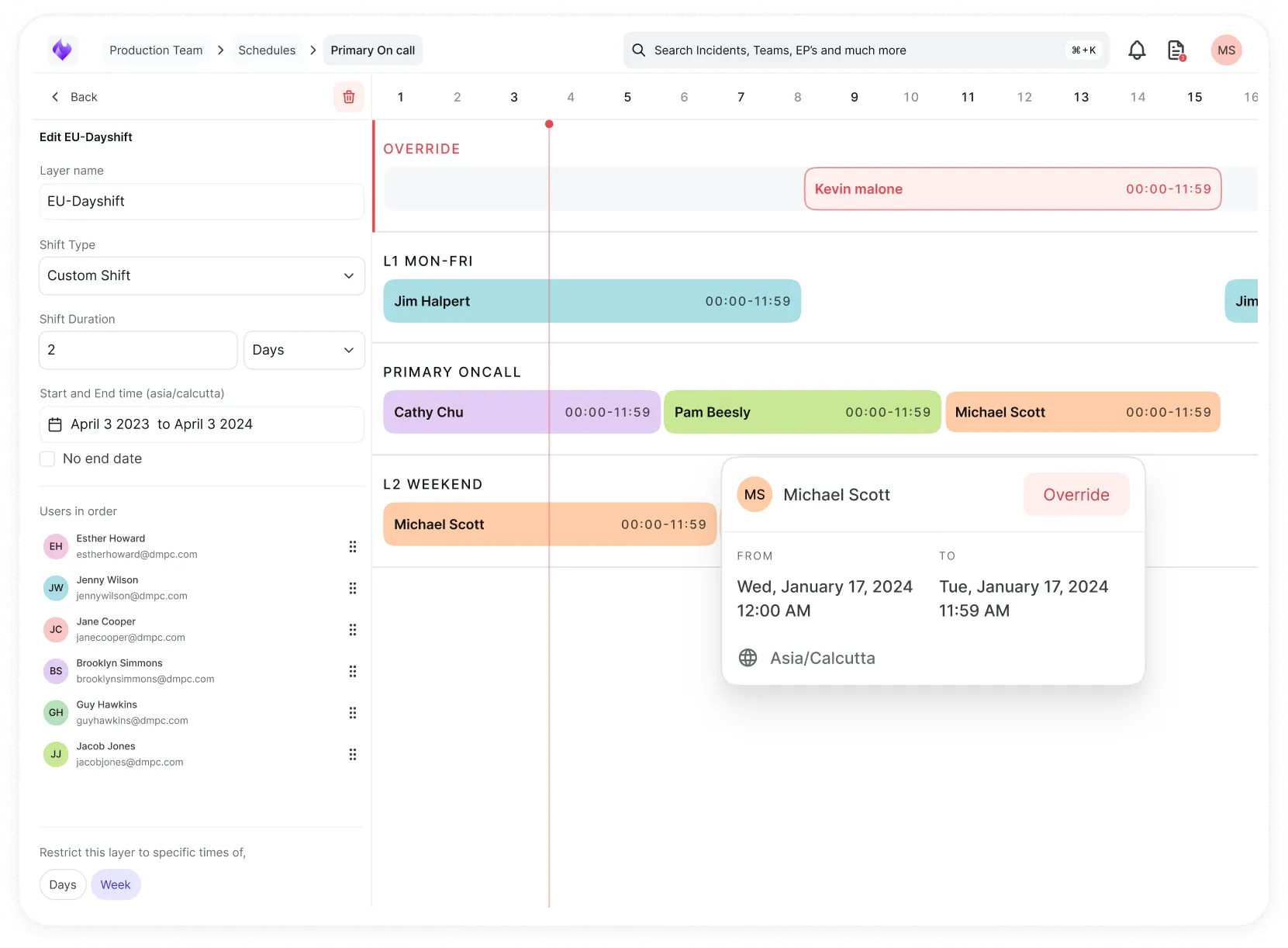
Simplify on-call scheduling, automate escalations, and reduce burnout.
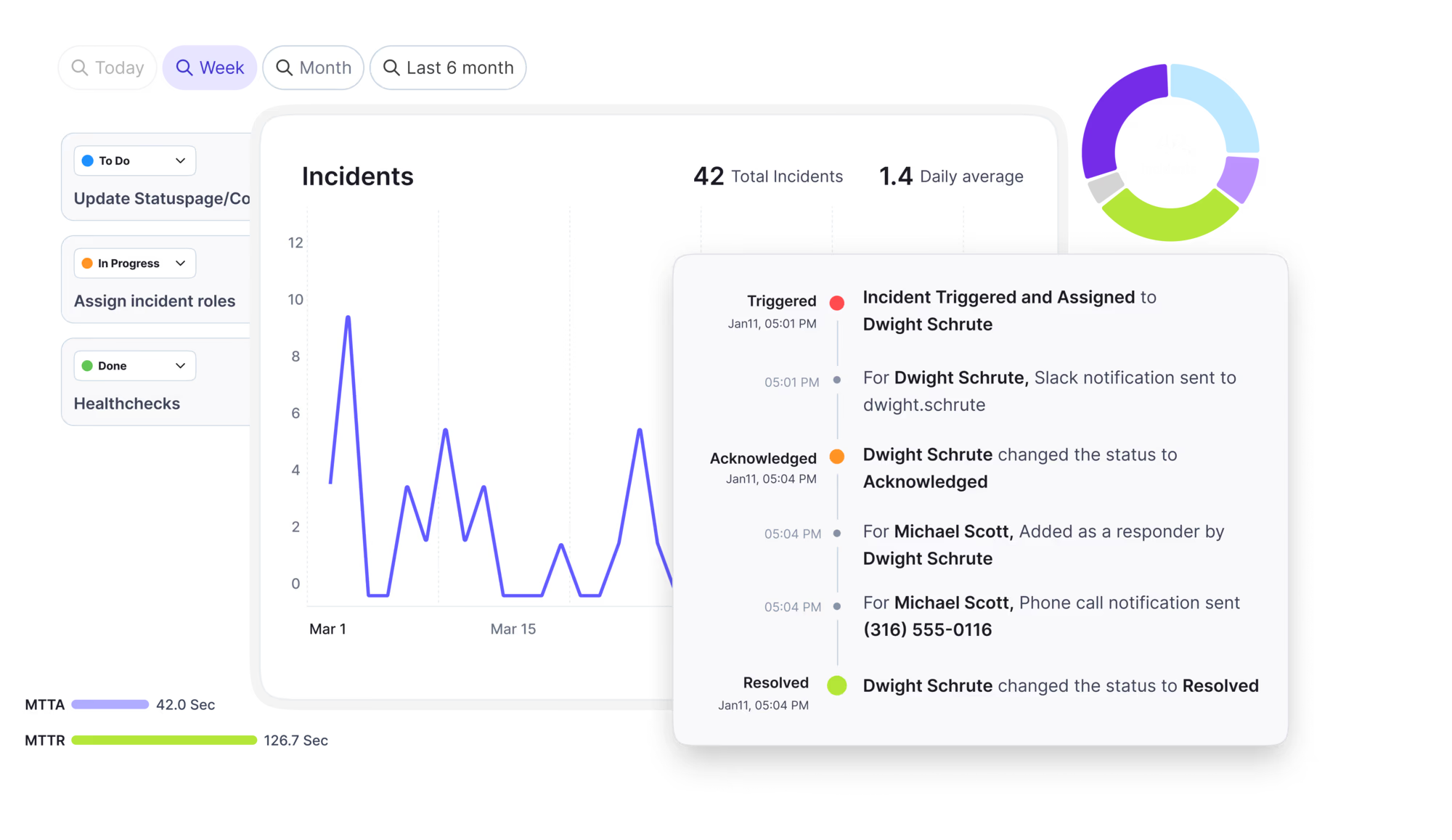
Automate postmortems, AI summaries, and post-incident workflows
Create, organize, and continuously improve your knowledge base to find the right answers with Sera AI.
We're here to help

The integration with Atlassian Jira using the Xurrent Integration Service is

The integration with Atlassian Jira using the Xurrent Integration Service is

The integration with Atlassian Jira using the Xurrent Integration Service is

The integration with Atlassian Jira using the Xurrent Integration Service is

The integration with Atlassian Jira using the Xurrent Integration Service is

The integration with Atlassian Jira using the Xurrent Integration Service is

The integration with Atlassian Jira using the Xurrent Integration Service is

The integration with Atlassian Jira using the Xurrent Integration Service is
Resolve issues quickly with an AI-powered system that automates ticketing.
Unifiy IT, HR, Facilities, Finance, and more on a single, AI-powered service platform.
Simplify on-call scheduling, automate escalations, and reduce burnout.
Automate postmortems, AI summaries, and post-incident workflows
Create, organize, and continuously improve your knowledge base to find the right answers with Sera AI.
Resolve plant floor and IT issues before they disrupt production.
Stay audit-ready while resolving issues and reducing operational risk.

Detect, respond, and resolve incidents fast to cut downtime and MTTR.

Keep your store online, even during your biggest sales moments.

Protect patient data and resolve issues fast, so care teams stay focused on care.

Standardize service delivery across every store and channel.

We are here to help 24/7

Connect with other Xurrent Users

Get insights and tips on how to get the most out of Xurrent

Apps, APIs, and updates

Xurrent service functionality

Eliminate manual tasks, optimize workflows, and deliver faster resolutions.
Learn how organizations have reduced downtime, improved 50% MTTA & MTTR, and cut costs with Xurrent IMR.
Discover Xurrent IMR's quick support, bidirectional integrations with Jira and Slack, and more cohesive incident response capabilities compared to Opsgenie.
Understand why users value Xurrent IMR for its intuitive interface, efficient incident alerting, customizable On-call schedules, and escalations.

Everyone knows the boy who cried wolf. He sounded the alarm for fun, the village came running, and after a few false alarms they stopped coming. Then the wolf showed up for real, and the story ends the way you remember.
Every on-call engineer is living the grown-up version. The alerts cry wolf all day, so you learn to tune them out. Then one night a page you'd have ignored is the outage, and by the time you look, it's already bad.
This is the problem alert correlation was built to solve. It's a genuine fix for one of the hardest parts of being on-call, and it's worth understanding how it works before you rely on it. That's what the rest of this page is for.
Let’s talk about scale, because scale is at the heart of the issue. A service provider running 700 devices can generate over 35,000 events in a single week, and during maintenance windows that volume spikes 300 to 400%. A single incident in a microservices environment routinely fans out into 50 or more alerts across Prometheus, an APM tool, log aggregators, and cloud dashboards, each firing independently for the same root cause.
When engineers see 500 to 1,200 alerts a day, they stop reading them. The cost shows up later, in the incidents that were sitting in the feed the whole time and nobody looked.
The first generation of this technology had a name: AIOps. Between roughly 2017 and 2022, platforms like Moogsoft and BigPanda used machine learning to cluster and deduplicate related alerts, turning a thousand raw events into one actionable incident with a causal chain attached. That was real progress, and for a class of problems it worked. Topological correlation grouped alerts from services that depend on each other. Temporal correlation grouped events that fired together. Semantic correlation grouped events with similar signatures.
But grouping is not understanding. A correlation engine can tell you with confidence that twelve alerts belong together. It cannot reliably tell you which of the twelve is the cause and which eleven are the echo.
This is the gap that has defined the category for a decade. The machine is good at "these things are related." It is weak at "here is why, and here is the one that matters." And a confident wrong answer to the second question is more dangerous than saying nothing, because it can fold a real incident into a group and mark the whole cluster resolved.
Two things shifted this year, and they are easy to conflate. The first is genuine: large language models and agentic systems moved the work upstream, from grouping alerts to investigating them. Elastic's observability team framed the maturity plainly: alert correlation and SLO-based alerting have made on-call meaningfully better over the past few years, and that problem is now relatively mature. The new frontier is the investigation itself, the cognitive overload after the page, when an engineer is context-switching between four tools under pressure.
New Relic's 2026 AI Impact Report, drawn from 6.6 million platform users, found that accounts using AI achieved twice the correlation rates and 27 percent less alert noise than non-AI accounts. It is worth repeating their own caveat: the data comes from their customer base, so read it as directional, not independently verified. That kind of self-skepticism is rarer than it should be in this category, and it is the right posture.
The second shift is louder and needs more care: Gartner published its first Market Guide for AI Site Reliability Engineering Tooling in January 2026, projecting that adoption will climb from under 5 percent of enterprises in 2025 to 85 percent by 2029. A category going from niche to near-universal in four years is a real signal. It is also exactly the kind of number that invites tools to slap "AI" on a rules engine and call it transformation.
Gartner's own warning in the same guide is the line every buyer should tape to their monitor:
Organizations that adopt AI SRE tooling focused on operations only will become better at reactively fixing incidents, but not at improving system reliability.
Gartner, Market Guide for AI SRE Tooling, January 2026
Here is the position we hold, and it is not the convenient one for a vendor to take. The value of AI alert correlation is not the percentage of noise it removes. You can remove 100 percent of the noise by turning off the alerts. The value is whether the on-call engineer trusts the grouped signal enough to act on it at 3am, and whether that trust is earned.
Trust is earned by two things the noise-reduction number never captures. The first is explainability. When the system groups twelve alerts into one incident, it has to show its work, the evidence it used and the reasoning it followed, so the engineer can verify the diagnosis before acting on it. A grouping you cannot inspect is a grouping you cannot trust, and an untrusted tool gets bypassed within a month.
The second is the cost of a wrong merge. Charity Majors has spent years arguing that the industry's instinct to bolt intelligence onto a pile of disconnected signals is backwards; the leverage is in richer, wider data you can actually ask questions of, not in more aggressive summarization of thin data. Applied to correlation, the point is sharp: an AI that groups aggressively on weak signals will eventually group a real incident into the wrong cluster. The Target breach in 2013 and the 3CX supply-chain attack in 2023 were both, in part, alert-fatigue failures, real signals sitting in a feed that humans had been trained to tune out.
So the real scorecard for any correlation feature is not "how much did it suppress." It is: when it grouped, was it right, could you see why, and on the day it was wrong, how loudly did it fail. A system that quietly buries the one alert that mattered has not reduced noise. It has manufactured a wolf.
We shipped Noise Reduction in Xurrent IMR with two correlation modes you control directly: time-based grouping for alerts that fire together, and content-based grouping for alerts that describe the same thing. Those are deterministic. You can read the rule, predict the behavior, and audit the result. We started there on purpose.
AI Alert Correlation is now in beta. It groups across the signals that the deterministic rules miss. It also shows the grouping logic, keeps a human in the loop, and defaults to surfacing rather than suppressing, because the failure mode we care about most is the quiet one. Gartner's guidance agrees on the principle: the human stays the approver, especially for the complex failures where an agent's confidence is least earned.
We think the teams that get the most out of this technology in 2026 will be the ones who treat it the way the better analysts already recommend: start with one real incident, measure what the tool actually changed, and widen the automation only as far along the trust gradient as the evidence justifies. That is slower than flipping on full autonomy. It is also the only version of this that survives contact with a 3AM page.
The wolf in the postmortem was not defeated by a better classifier. It was defeated, eventually, by someone deciding which alerts were worth a human's trust and which were not. AI can make that judgment faster and apply it at a scale no on-call rotation can match. It cannot be handed the judgment itself. Not yet, and not quietly.
AI Alert Correlation is in beta in Xurrent IMR. If you want to see how the grouping logic surfaces its reasoning, book a walkthrough.
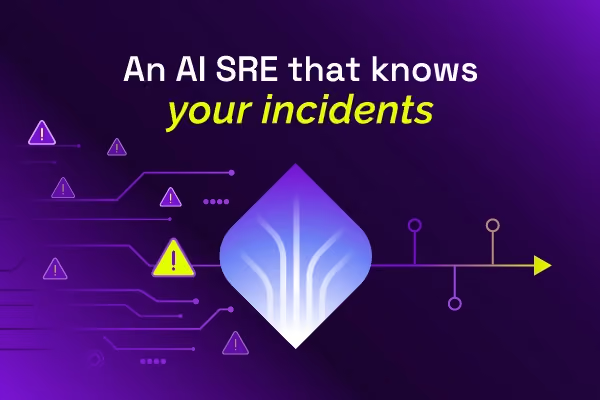
Most AI SREs are pattern matchers trained on public data. They know what a memory leak looks like in the abstract. They don't know that your payments-api has a flaky liveness probe everyone ignores, that the checkout team owns the retry policy, or that the last three "database incidents" were actually cache misconfigurations. That knowledge lives in your postmortems, your Slack channels, and the heads of two senior engineers.
Most AI SREs are pattern matchers trained on public data. They know what a memory leak looks like in the abstract. They don't know that your payments-api has a flaky liveness probe everyone ignores, that the checkout team owns the retry policy, or that the last three "database incidents" were actually cache misconfigurations. That knowledge lives in your postmortems, your Slack channels, and the heads of two senior engineers.
.avif)