




Blog
Insights & updates from our experts


Resolve plant floor and IT issues before they disrupt production.

Stay audit-ready while resolving issues and reducing operational risk.
Resolve issues quickly with an AI-powered system that automates ticketing.
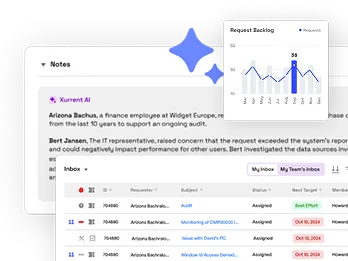
Unifiy IT, HR, Facilities, Finance, and more on a single, AI-powered service platform.
Simplify on-call scheduling, automate escalations, and reduce burnout.
Automate postmortems, AI summaries, and post-incident workflows
Create, organize, and continuously improve your knowledge base to find the right answers with Sera AI.
We're here to help

The integration with Atlassian Jira using the Xurrent Integration Service is

The integration with Atlassian Jira using the Xurrent Integration Service is

The integration with Atlassian Jira using the Xurrent Integration Service is

The integration with Atlassian Jira using the Xurrent Integration Service is

The integration with Atlassian Jira using the Xurrent Integration Service is

The integration with Atlassian Jira using the Xurrent Integration Service is

The integration with Atlassian Jira using the Xurrent Integration Service is

The integration with Atlassian Jira using the Xurrent Integration Service is
Resolve issues quickly with an AI-powered system that automates ticketing.
Unifiy IT, HR, Facilities, Finance, and more on a single, AI-powered service platform.
Simplify on-call scheduling, automate escalations, and reduce burnout.
Automate postmortems, AI summaries, and post-incident workflows
Create, organize, and continuously improve your knowledge base to find the right answers with Sera AI.
Resolve plant floor and IT issues before they disrupt production.
Stay audit-ready while resolving issues and reducing operational risk.

Detect, respond, and resolve incidents fast to cut downtime and MTTR.

Keep your store online, even during your biggest sales moments.

Protect patient data and resolve issues fast, so care teams stay focused on care.

Standardize service delivery across every store and channel.

We are here to help 24/7

Connect with other Xurrent Users

Get insights and tips on how to get the most out of Xurrent

Apps, APIs, and updates

Xurrent service functionality

Eliminate manual tasks, optimize workflows, and deliver faster resolutions.
Learn how organizations have reduced downtime, improved 50% MTTA & MTTR, and cut costs with Xurrent IMR.
Discover Xurrent IMR's quick support, bidirectional integrations with Jira and Slack, and more cohesive incident response capabilities compared to Opsgenie.
Understand why users value Xurrent IMR for its intuitive interface, efficient incident alerting, customizable On-call schedules, and escalations.
A Large Language Model (LLM) is a deep learning AI system trained on massive text datasets—often billions of words—to understand, generate, and manipulate human language. LLMs use transformer-based neural network architectures (the underlying model structure that processes sequences of text by analyzing relationships between words) to predict and produce contextually relevant text responses. In enterprise IT and service operations, LLMs power virtual agents, automated ticket summarization, knowledge article generation, incident response guidance, and conversational interfaces that reduce manual workload and accelerate resolution workflows. Unlike traditional rule-based chatbots or keyword-matching systems, LLMs learn statistical patterns across language, enabling them to handle ambiguous queries, generate coherent multi-sentence responses, and adapt to domain-specific terminology when fine-tuned or augmented with organizational data.
LLMs directly impact operational efficiency, MTTR, and service quality by automating repetitive language-intensive tasks that previously required human judgment. In ITSM and incident management workflows, LLMs classify and route tickets faster than manual triage, draft knowledge base articles from resolved incidents, summarize lengthy postmortem threads, and provide real-time resolution guidance to on-call engineers—reducing first-response time and improving FCR rates. For service desks handling high ticket volumes, LLM-powered virtual agents deflect routine requests (password resets, access provisioning, policy lookups) before they reach live agents, cutting support costs and freeing specialists for complex issues. In DevOps and SRE contexts, LLMs assist with alert correlation, runbook generation, and root cause hypothesis during incidents, accelerating diagnosis when every minute of downtime carries revenue and reputation risk.
The consequences of poorly implemented LLMs include hallucinations (confidently generated but factually incorrect responses), data leakage when sensitive operational context is sent to third-party model providers, and user frustration when responses lack organizational context or fail to integrate with existing workflows. Organizations that deploy LLMs without secure data isolation, retrieval-augmented generation (RAG) architectures, or human-in-the-loop validation risk compliance violations, eroded trust, and increased support escalations. Conversely, well-architected LLM integrations—such as those using AWS Bedrock with BYOK encryption and private model inference—deliver measurable productivity gains while maintaining SOC 2 and ISO 27001 compliance.
LLMs are trained in two primary phases: pre-training and fine-tuning. During pre-training, the model ingests vast public text corpora (web pages, books, code repositories) and learns to predict the next word in a sequence, building a statistical understanding of grammar, facts, reasoning patterns, and domain knowledge. This phase produces a general-purpose foundation model capable of handling diverse language tasks. In the fine-tuning phase, the model is further trained on smaller, task-specific datasets—such as historical support tickets, incident reports, or knowledge articles—to specialize in organizational vocabulary, workflows, and response styles.
At inference (when the model generates a response), the LLM receives a prompt (user query or system instruction), processes it through multiple transformer layers that weigh contextual relationships between words, and outputs a probability distribution over possible next tokens, selecting the most likely sequence to form a coherent answer. Enterprise deployments often enhance this process with RAG, where the LLM queries an external knowledge base (CMDB, runbooks, past incidents) before generating a response, grounding its output in verified organizational data rather than relying solely on pre-trained knowledge. This architecture reduces hallucinations and ensures responses reflect current policies, configurations, and procedures.
Model performance depends on architecture size (measured in parameters—billions of weights that encode learned patterns), training data quality, and inference optimization. Larger models generally produce more nuanced responses but require more compute resources and latency management. Organizations balance model capability against response time, cost, and security requirements, often deploying smaller specialized models for real-time interactions and reserving larger models for complex analysis tasks.
- Service Desk Ticket Classification and Routing : A mid-sized enterprise integrates an LLM into its ITSM platform to automatically classify incoming tickets by category (incident, request, problem) and route them to the appropriate support queue based on extracted keywords, sentiment, and historical resolution patterns. The LLM reduces average ticket assignment time from 8 minutes to under 30 seconds, improving SLA adherence and allowing agents to focus on resolution rather than triage.
- Incident Postmortem Summarization for SRE Teams : A DevOps team uses an LLM to generate concise postmortem summaries from lengthy Slack threads, PagerDuty timelines, and Jira comments following a production outage. The model extracts root cause, timeline of events, mitigation steps, and action items into a structured document, cutting postmortem authoring time from 2 hours to 15 minutes and ensuring consistent documentation quality across incidents.
- Knowledge Article Generation from Resolved Tickets : An IT operations team deploys an LLM that monitors resolved tickets and automatically drafts knowledge base articles for recurring issues, including symptom descriptions, troubleshooting steps, and resolution procedures. The model submits drafts for human review, increasing knowledge article creation rate by 60% and improving self-service deflection as users find answers faster in the updated knowledge base.
- Generative AI
- AIOps (Artificial Intelligence for IT Operations)
- NLP (Natural Language Processing)
- RAG (Retrieval-Augmented Generation)
- Virtual Agent
---

.webp)
.webp)