


Xurrent Glossary
#
AIOps (Artificial Intelligence for IT Operations)
The application of AI and machine learning to automate and enhance IT operations, including anomaly detection, event correlation, and root cause analysis.
#
Agentic AI
An emerging paradigm of AI that includes autonomous agents capable of planning, reasoning, and acting independently to achieve goals across complex environments.
#
Availability Management
Ensure that services are available when users need them.
#
CI (Configuration Item)
Any component that needs to be managed in order to deliver an IT service. Can include hardware, software, documentation, etc.
#
CMDB (Configuration Management Database)
A database used to store information about hardware and software assets (Configuration Items).
#
CSI (Continual Service Improvement)
A process that uses quality management methods to learn from past successes and failures.
#
Capacity and Performance Management
Ensure services meet performance targets now and in the future.
#
Case Management
A way of managing service interactions that require investigation, follow-up, or documentation over time.
#
Change
The addition, modification, or removal of anything that could affect IT services.
#
Change Advisory Board
Group that evaluates change requests.
#
Change Advisory Board (CAB)
A group of stakeholders who evaluate and approve or reject proposed changes.
#
Change Enablement (Management)
Ensure that changes are made with minimal risk and disruption.
#
Change Manager
Ensures changes are implemented with minimal disruption and proper planning.
#
Configuration Item
Component of IT infrastructure tracked in the CMDB.
#
Configuration Management
Maintain information about Configuration Items and their relationships.
#
Configuration Management Database
Repository of configuration information and relationships.
#
Configuration Manager
Maintains the integrity of configuration information.
#
Continual Improvement
Align services and processes with changing business needs through ongoing enhancements.
#
Customer Satisfaction
A measure of customer happiness with service received.
#
Digital Twin
A virtual model of a system, asset, or process used for real-time monitoring and simulation.
#
Digital Workplace
A virtual environment that enables employees to access tools, applications, and services they need to perform their jobs efficiently.
#
ESM (Enterprise Service Management)
The application of ITSM principles to non-IT departments (e.g., HR, Facilities, Legal, Finance) to improve service delivery across the business.
#
First Contact Resolution
Percentage of tickets resolved during the first interaction.
#
Generative AI
A class of AI models capable of generating new content (text, images, code, etc.) based on learned patterns.
#
Hyperautomation
The coordinated use of AI, robotic process automation (RPA), and other technologies to automate complex business processes.
#
IT Asset Management (ITAM)
Manage the lifecycle of IT assets to maximize value and minimize risks.
#
ITIL (Information Technology Infrastructure Library)
A framework of best practices for delivering IT services. It provides detailed descriptions of key IT practices and processes.
#
ITSM (IT Service Management)
A set of policies and processes used to design, deliver, manage, and improve IT services offered to customers.
#
Incident
An unplanned interruption or reduction in quality of an IT service.
#
Incident Management
Restore normal service operation as quickly as possible after an interruption.
#
Incident Manager
Oversees the incident management process and ensures timely resolution.
#
Information Security Management
Protect information assets through confidentiality, integrity, and availability controls.
#
KPI (Key Performance Indicator)
A measurable value that indicates how effectively a service or process is achieving key objectives.
#
Knowledge Management
The process of capturing, structuring, and sharing knowledge (often enhanced by AI to auto-suggest or improve articles).
#
LLM (Large Language Model)
A type of generative AI trained on massive text datasets to understand and generate human-like language (e.g., GPT-4, Claude, Gemini).
#
MCP Server (Model Control Plane Server)
A backend service or orchestration layer that manages access, permissions, model routing, and interactions for AI models across environments or applications. Often used in enterprise AI deployments to govern and abstract model infrastructure.
#
Machine Learning
A subset of AI where algorithms learn from data to make predictions or decisions without explicit programming.
#
Mean Time Between Failures
Average time between service failures.
#
Mean Time to Repair
Average time taken to resolve a service issue.
#
Monitoring and Event Management
Detect events and take appropriate action to maintain service health.
#
NLP (Natural Language Processing)
A field of AI that enables machines to understand, interpret, and generate human language. Core to chatbots, summarization, sentiment analysis, and more.
#
OLA (Operational Level Agreement)
An agreement between internal support groups that supports SLA delivery.
#
Operational Level Agreement
Internal agreement supporting SLAs.
#
Problem
The underlying cause of one or more incidents.
#
Problem Management
Prevent incidents from recurring by identifying root causes and implementing fixes.
#
Problem Manager
Identifies and resolves root causes of incidents.
#
Process Owner
Responsible for defining and improving a particular ITSM process.
#
RAG (Retrieval-Augmented Generation)
An architecture that enhances LLMs by combining them with external data sources during inference to generate more accurate and up-to-date responses.
#
Recovery Point Objective
Maximum acceptable data loss measured in time.
#
Recovery Time Objective
Maximum acceptable time to restore a service after disruption.
#
Release Management
Plan, schedule, and control the movement of releases to test and live environments.
#
Request (Service Request)
A user request for information, access to a service, or a standard change.
#
Return on Investment
A measure of the financial return of an initiative.
#
SLA (Service Level Agreement)
A documented agreement between a service provider and a customer that identifies expected service performance.
#
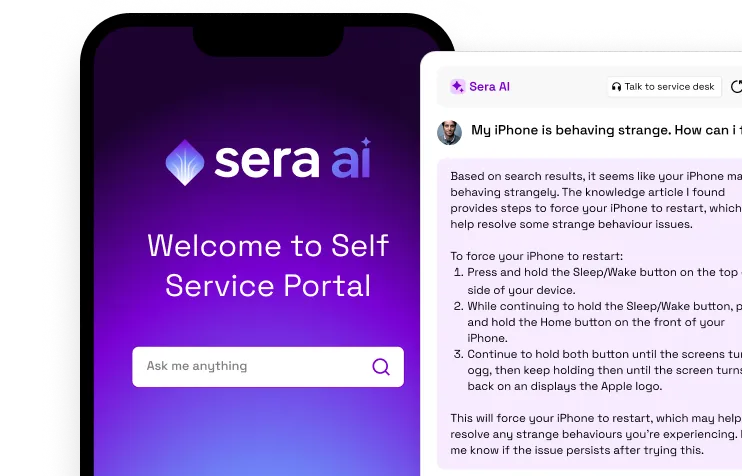
Self-Service Portal
A digital interface where users can find information, submit tickets, or request services without needing live support.
#
Service
A means of delivering value to customers by facilitating outcomes they want to achieve without owning specific costs and risks.
#
Service Catalog
A structured document or database of available services provided by the enterprise or IT.
#
Service Desk
The single point of contact between users and the service provider.
#
Service Desk Agent
Provides front-line support and interacts directly with users.
#
Service Level Agreement
Defines service expectations and responsibilities.
#
Service Level Indicator
A specific metric that measures the performance of a service (e.g., uptime, latency).
#
Service Level Management
Ensure that all services are delivered in line with agreed service levels.
#
Service Level Objective
A target value or range for an SLI, defining the expected level of service performance.
#
Service Owner
Accountable for the delivery and performance of a specific service.
#
Service Portal
A user-facing interface for submitting requests, incidents, or accessing the service catalog.
#
Service Request Management
Handle user requests in an efficient and user-friendly manner.
#
Shared Services
A business model in which support functions (like HR or Finance) are centralized and delivered as a service across the organization.
#
Supervised Machine Learning
A machine learning approach that uses labeled training data to learn the mapping between inputs and known outputs.
#
Total Cost of Ownership
The overall cost of owning and managing a service or asset.
#
Underpinning Contract
Contract with an external vendor that supports an SLA.
#
Unsupervised Machine Learning
A machine learning approach that identifies patterns or structures in unlabeled data (e.g., clustering, anomaly detection).
#
Virtual Agent
An AI-powered chatbot or assistant that can handle user requests, answer questions, and perform actions without human intervention.
#
Webhooks
A webhook is a way for one app to automatically send data to another app the instant something happens, instead of the second app having to keep checking for updates.
#
Workflow Automation
Technology that automates manual tasks and processes in service delivery.