





Blog
Insights & updates from our experts


Resolve plant floor and IT issues before they disrupt production.

Stay audit-ready while resolving issues and reducing operational risk.
Resolve issues quickly with an AI-powered system that automates ticketing.
Unifiy IT, HR, Facilities, Finance, and more on a single, AI-powered service platform.
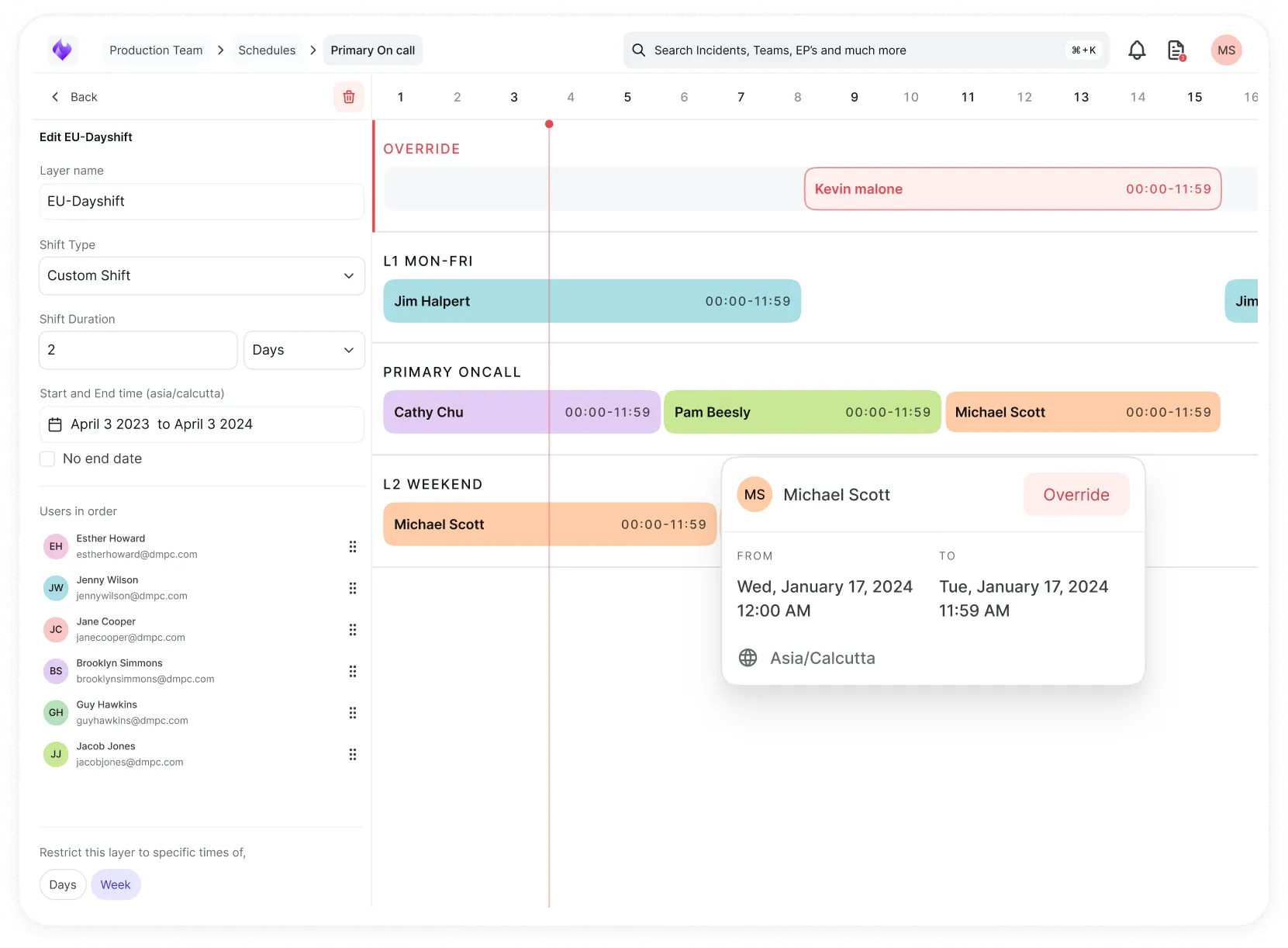
Simplify on-call scheduling, automate escalations, and reduce burnout.
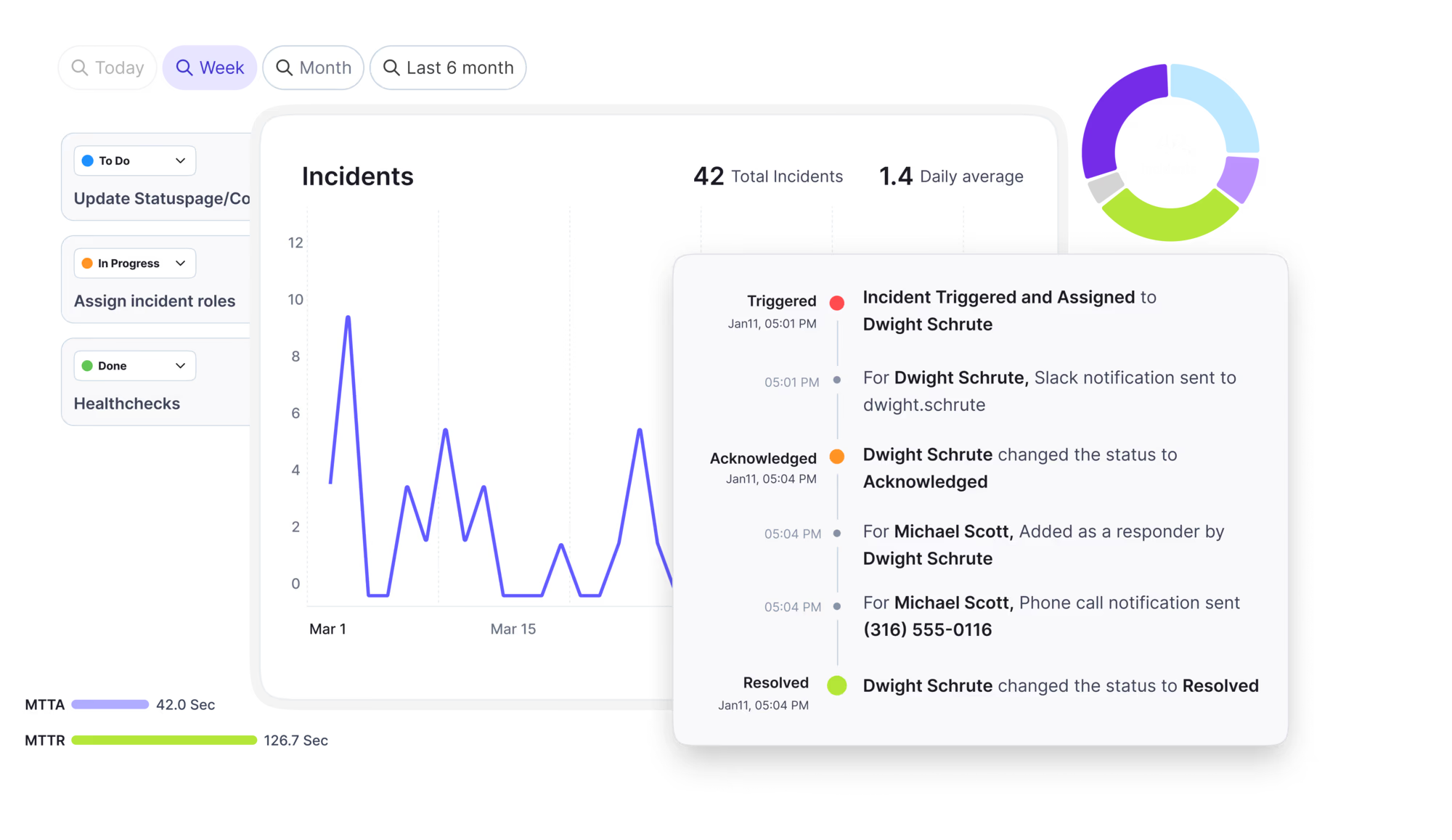
Automate postmortems, AI summaries, and post-incident workflows
Create, organize, and continuously improve your knowledge base to find the right answers with Sera AI.

We're here to help

The integration with Atlassian Jira using the Xurrent Integration Service is

The integration with Atlassian Jira using the Xurrent Integration Service is

The integration with Atlassian Jira using the Xurrent Integration Service is

The integration with Atlassian Jira using the Xurrent Integration Service is

The integration with Atlassian Jira using the Xurrent Integration Service is

The integration with Atlassian Jira using the Xurrent Integration Service is

The integration with Atlassian Jira using the Xurrent Integration Service is

The integration with Atlassian Jira using the Xurrent Integration Service is
Resolve issues quickly with an AI-powered system that automates ticketing.
Unifiy IT, HR, Facilities, Finance, and more on a single, AI-powered service platform.
Simplify on-call scheduling, automate escalations, and reduce burnout.
Automate postmortems, AI summaries, and post-incident workflows
Create, organize, and continuously improve your knowledge base to find the right answers with Sera AI.
Resolve plant floor and IT issues before they disrupt production.
Stay audit-ready while resolving issues and reducing operational risk.

Detect, respond, and resolve incidents fast to cut downtime and MTTR.

Keep your store online, even during your biggest sales moments.

Protect patient data and resolve issues fast, so care teams stay focused on care.

Standardize service delivery across every store and channel.

We are here to help 24/7

Connect with other Xurrent Users

Get insights and tips on how to get the most out of Xurrent

Apps, APIs, and updates

Xurrent service functionality

Eliminate manual tasks, optimize workflows, and deliver faster resolutions.
Learn how organizations have reduced downtime, improved 50% MTTA & MTTR, and cut costs with Xurrent IMR.
Discover Xurrent IMR's quick support, bidirectional integrations with Jira and Slack, and more cohesive incident response capabilities compared to Opsgenie.
Understand why users value Xurrent IMR for its intuitive interface, efficient incident alerting, customizable On-call schedules, and escalations.
A Configuration Management Database (CMDB) is a centralized repository that stores detailed information about Configuration Items (CIs)—the hardware, software, network devices, applications, documentation, and other components that make up an IT environment—and the relationships between them. The CMDB serves as the authoritative source of record for IT infrastructure and service dependencies, enabling teams to understand how changes to one component might affect others, trace the root cause of incidents, and maintain accurate asset inventories. Originally formalized in ITIL (Information Technology Infrastructure Library) as a core component of Configuration Management, the CMDB captures not just static attributes like server specifications or software versions, but also dynamic relationships such as which applications depend on which databases, which services run on which virtual machines, and which business processes rely on which technical components.
The CMDB directly impacts incident response speed, change success rates, and operational risk management. When an outage occurs, responders use the CMDB to quickly identify affected services, dependent systems, and responsible teams—reducing mean time to resolution (MTTR) by eliminating manual discovery work. During change planning, teams query the CMDB to assess blast radius and identify stakeholders, preventing unintended service disruptions that result from incomplete impact analysis. For compliance and audit purposes, the CMDB provides traceable records of system configurations, software licenses, and security controls, supporting ISO 27001, SOC 2, and regulatory requirements.
Without an accurate CMDB, organizations face blind spots: changes are made without understanding downstream dependencies, incidents escalate because the right team cannot be identified, and asset inventories drift out of sync with reality. The cost of CMDB neglect includes repeated incidents from the same root causes, failed changes that trigger emergency rollbacks, and audit findings that expose gaps in configuration control. For enterprises managing thousands of CIs across hybrid cloud and on-premises environments, the CMDB becomes the operational map that prevents chaos.
The CMDB operates through continuous data collection, relationship mapping, and synchronization across IT systems. Discovery tools—ranging from network scanners to cloud API integrations—automatically detect and catalog CIs, capturing attributes such as hostname, IP address, operating system, installed software, and hardware specifications. Integration with ITSM platforms, monitoring tools, and asset management systems ensures that the CMDB remains current as infrastructure changes.
Relationship modeling defines how CIs connect: a web application CI links to its database CI, which runs on a virtual machine CI, which resides on a physical host CI, which supports a business service CI. These relationships enable impact analysis—when a database server goes offline, the CMDB instantly identifies every application and business process affected. Configuration baselines establish approved states for CIs, allowing teams to detect drift and enforce standards.
Data governance processes maintain CMDB accuracy through regular reconciliation, deduplication, and validation. Automated workflows update the CMDB when changes are approved, tickets are resolved, or new assets are provisioned. Access controls ensure that only authorized personnel can modify CI records, while audit trails track every change to configuration data. The CMDB typically integrates with incident, problem, and change management workflows, providing context at every stage of the service lifecycle.
- Financial services incident response : A bank's payment processing system experiences intermittent failures. The on-call SRE queries the CMDB to identify all dependencies—discovering that a recent database patch affected a shared connection pool used by three critical applications. The CMDB relationship map shows which teams own each affected service, enabling coordinated rollback within 20 minutes instead of hours of manual investigation.
- Healthcare change impact assessment : A hospital IT team plans to upgrade its electronic health records (EHR) system. Before scheduling the change, they use the CMDB to identify every downstream integration—lab systems, pharmacy applications, billing platforms, and clinical decision support tools. The CMDB reveals that 14 services depend on specific API versions, prompting the team to coordinate testing with each service owner and schedule the upgrade during a planned maintenance window.
- Manufacturing compliance audit : An automotive manufacturer undergoes an ISO 27001 audit requiring evidence of configuration control for systems handling customer data. The CMDB provides auditors with a complete inventory of servers, databases, and applications in scope, along with documented relationships to security controls, patch levels, and responsible teams. Automated CMDB reports demonstrate that all production systems meet baseline configuration standards, satisfying audit requirements without manual spreadsheet compilation.
- Configuration Item
- Configuration Management
- Change Management
- Incident Management
- IT Asset Management (ITAM)
---

.webp)
.webp)