




Blog
Insights & updates from our experts


Resolve plant floor and IT issues before they disrupt production.

Stay audit-ready while resolving issues and reducing operational risk.
Resolve issues quickly with an AI-powered system that automates ticketing.
Unifiy IT, HR, Facilities, Finance, and more on a single, AI-powered service platform.
Simplify on-call scheduling, automate escalations, and reduce burnout.
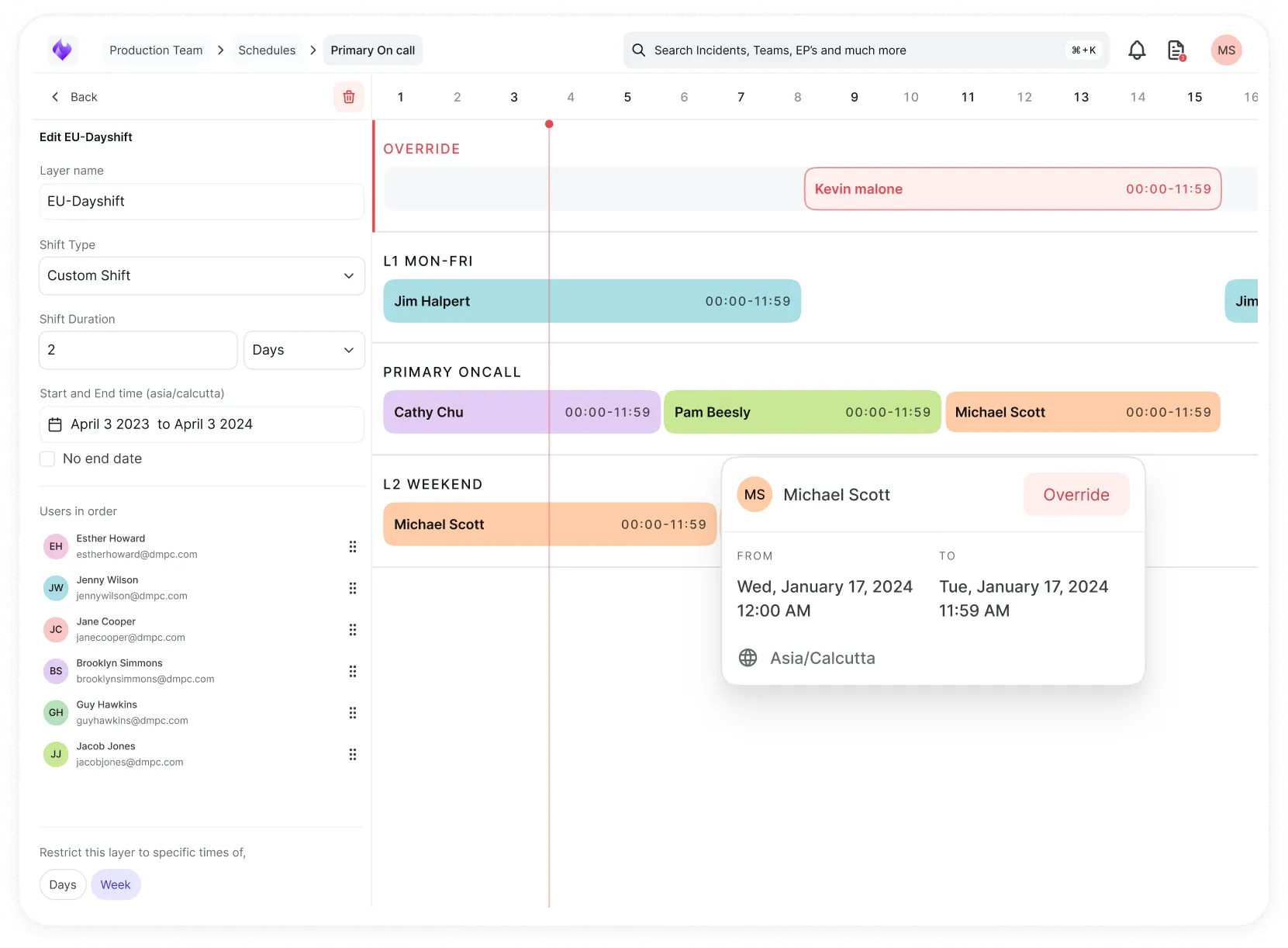
Automate postmortems, AI summaries, and post-incident workflows
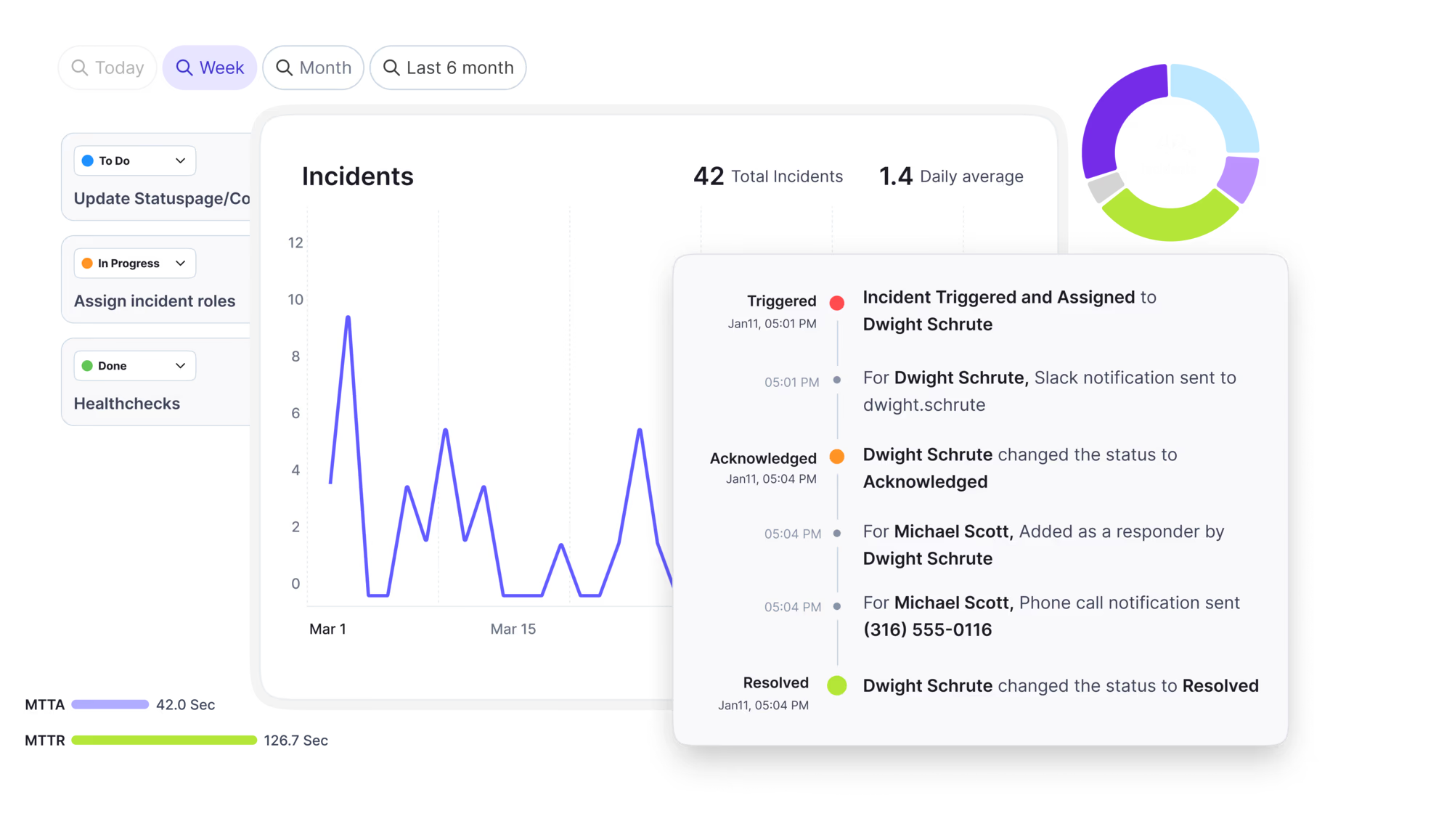
Create, organize, and continuously improve your knowledge base to find the right answers with Sera AI.

We're here to help

The integration with Atlassian Jira using the Xurrent Integration Service is

The integration with Atlassian Jira using the Xurrent Integration Service is

The integration with Atlassian Jira using the Xurrent Integration Service is

The integration with Atlassian Jira using the Xurrent Integration Service is

The integration with Atlassian Jira using the Xurrent Integration Service is

The integration with Atlassian Jira using the Xurrent Integration Service is

The integration with Atlassian Jira using the Xurrent Integration Service is

The integration with Atlassian Jira using the Xurrent Integration Service is
Resolve issues quickly with an AI-powered system that automates ticketing.
Unifiy IT, HR, Facilities, Finance, and more on a single, AI-powered service platform.
Simplify on-call scheduling, automate escalations, and reduce burnout.
Automate postmortems, AI summaries, and post-incident workflows
Create, organize, and continuously improve your knowledge base to find the right answers with Sera AI.
Resolve plant floor and IT issues before they disrupt production.
Stay audit-ready while resolving issues and reducing operational risk.

Detect, respond, and resolve incidents fast to cut downtime and MTTR.

Keep your store online, even during your biggest sales moments.

Protect patient data and resolve issues fast, so care teams stay focused on care.

Standardize service delivery across every store and channel.

We are here to help 24/7

Connect with other Xurrent Users

Get insights and tips on how to get the most out of Xurrent

Apps, APIs, and updates

Xurrent service functionality

Eliminate manual tasks, optimize workflows, and deliver faster resolutions.
Learn how organizations have reduced downtime, improved 50% MTTA & MTTR, and cut costs with Xurrent IMR.
Discover Xurrent IMR's quick support, bidirectional integrations with Jira and Slack, and more cohesive incident response capabilities compared to Opsgenie.
Understand why users value Xurrent IMR for its intuitive interface, efficient incident alerting, customizable On-call schedules, and escalations.
A CMDB (Configuration Management Database) is a centralized repository that stores detailed information about Configuration Items (CIs) — the hardware, software, network devices, applications, documentation, and other components that make up an IT environment — and the relationships between them. The CMDB tracks each CI's attributes (such as hostname, IP address, owner, location, and version), dependencies, and upstream/downstream connections, creating a live map of the infrastructure that shows what you have, where it runs, how components interact, and what breaks if a single piece fails. In ITSM frameworks like ITIL, the CMDB is the authoritative source for configuration data used across incident, problem, change, and release management processes, ensuring that service desk agents, engineers, and managers operate from a single, accurate view of the environment rather than scattered spreadsheets or outdated diagrams.
The CMDB is the foundation for informed decision-making during incidents, changes, and capacity planning. When an incident occurs, responders use the CMDB to identify which services depend on the failing component, trace the blast radius, and prioritize remediation based on business impact rather than guessing. During change management, the CMDB reveals which systems will be affected by a proposed update, reducing the risk of unintended outages and enabling accurate impact assessments and rollback plans. Without a reliable CMDB, teams operate blind — incidents take longer to resolve because dependencies are unknown, changes introduce unexpected failures, and root cause analysis becomes guesswork. A well-maintained CMDB accelerates MTTR, improves first-call resolution rates, supports compliance audits by documenting asset ownership and configuration baselines, and enables proactive problem management by surfacing patterns in CI failures. Conversely, a neglected or inaccurate CMDB — often called a "database of lies" — erodes trust, leading teams to bypass it entirely and revert to manual discovery during every incident.
The CMDB operates through continuous discovery, data integration, and relationship mapping. Discovery tools — ranging from network scanners and agent-based software to cloud API integrations — automatically detect CIs across on-premises, hybrid, and cloud environments, capturing attributes like configuration files, installed software versions, and network topology. This data feeds into the CMDB, where normalization and reconciliation processes deduplicate records, resolve conflicts between data sources, and maintain a single source of truth. Relationship mapping defines dependencies between CIs: a web application CI links to its database server, load balancer, and underlying virtual machines, which in turn link to physical hosts, storage arrays, and network switches. These relationships enable impact analysis (if this server fails, which services go down?) and change impact assessment (if we patch this OS, what applications are affected?). The CMDB integrates with ITSM workflows so that incident tickets automatically populate with affected CIs, change requests trigger dependency checks, and problem records link to recurring failure patterns in specific hardware or software versions. Governance processes — including regular audits, data quality metrics, and defined ownership — ensure the CMDB remains accurate as the environment evolves through deployments, decommissions, and configuration drift.
- Financial services incident response : A bank's service desk receives alerts that online banking is down; the CMDB instantly shows that the failing application server also supports mobile banking and ATM transaction processing, allowing the team to declare a high-severity incident, notify the correct escalation chain, and communicate accurate impact to executives and customers within minutes rather than spending an hour manually tracing dependencies.
- Healthcare change management : A hospital IT team plans to upgrade the operating system on servers hosting the electronic health records (EHR) system; the CMDB reveals that the EHR application, lab integration middleware, and radiology PACS all depend on those servers, triggering a formal change advisory board review, extended maintenance window, and coordinated testing plan that prevents a failed upgrade from disrupting patient care.
- Managed service provider (MSP) multi-tenant operations : An MSP uses a federated CMDB to track CIs across 50 client environments, with strict data segregation enforced through account trusts; when a client reports slow performance, the MSP's engineers query the CMDB to identify which virtualization host, storage LUN, and network segment serve that client's workloads, isolating the issue to a saturated storage array without accessing other clients' configuration data.
- CI (Configuration Item)
- Configuration Management
- Change Enablement (Management)
- Incident Management
- IT Asset Management (ITAM)
---

.webp)
.webp)