




Blog
Insights & updates from our experts


Resolve plant floor and IT issues before they disrupt production.

Stay audit-ready while resolving issues and reducing operational risk.
Resolve issues quickly with an AI-powered system that automates ticketing.
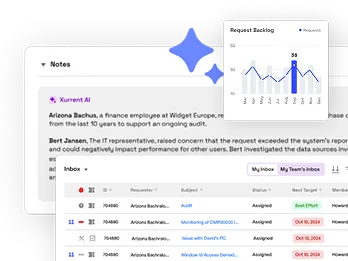
Unifiy IT, HR, Facilities, Finance, and more on a single, AI-powered service platform.
Simplify on-call scheduling, automate escalations, and reduce burnout.
Automate postmortems, AI summaries, and post-incident workflows
Create, organize, and continuously improve your knowledge base to find the right answers with Sera AI.
We're here to help

The integration with Atlassian Jira using the Xurrent Integration Service is

The integration with Atlassian Jira using the Xurrent Integration Service is

The integration with Atlassian Jira using the Xurrent Integration Service is

The integration with Atlassian Jira using the Xurrent Integration Service is

The integration with Atlassian Jira using the Xurrent Integration Service is

The integration with Atlassian Jira using the Xurrent Integration Service is

The integration with Atlassian Jira using the Xurrent Integration Service is

The integration with Atlassian Jira using the Xurrent Integration Service is
Resolve issues quickly with an AI-powered system that automates ticketing.
Unifiy IT, HR, Facilities, Finance, and more on a single, AI-powered service platform.
Simplify on-call scheduling, automate escalations, and reduce burnout.
Automate postmortems, AI summaries, and post-incident workflows
Create, organize, and continuously improve your knowledge base to find the right answers with Sera AI.
Resolve plant floor and IT issues before they disrupt production.
Stay audit-ready while resolving issues and reducing operational risk.

Detect, respond, and resolve incidents fast to cut downtime and MTTR.

Keep your store online, even during your biggest sales moments.

Protect patient data and resolve issues fast, so care teams stay focused on care.

Standardize service delivery across every store and channel.

We are here to help 24/7

Connect with other Xurrent Users

Get insights and tips on how to get the most out of Xurrent

Apps, APIs, and updates

Xurrent service functionality

Eliminate manual tasks, optimize workflows, and deliver faster resolutions.
Learn how organizations have reduced downtime, improved 50% MTTA & MTTR, and cut costs with Xurrent IMR.
Discover Xurrent IMR's quick support, bidirectional integrations with Jira and Slack, and more cohesive incident response capabilities compared to Opsgenie.
Understand why users value Xurrent IMR for its intuitive interface, efficient incident alerting, customizable On-call schedules, and escalations.
Shared Services is an organizational model in which common support functions—such as IT, HR, Finance, Facilities, or Legal—are consolidated into a centralized unit that delivers standardized services to multiple business units, departments, or external clients across the enterprise. Rather than each division maintaining its own separate service desk, procurement team, or infrastructure management group, Shared Services pools these capabilities into a single, specialized entity that operates with defined service levels, consistent processes, and economies of scale. In ITSM and ESM contexts, Shared Services typically refers to the centralized delivery of IT support, service request fulfillment, incident management, and operational functions to internal customers, often governed by Service Level Agreements (SLAs) and measured through performance metrics like first contact resolution and mean time to repair.
Shared Services directly impacts operational efficiency, cost control, and service quality across the organization. By eliminating duplicate service desks, overlapping toolsets, and inconsistent processes, enterprises reduce overhead and improve resource utilization—a single team of specialists can serve thousands of employees more effectively than fragmented departmental support groups. Standardized workflows and centralized knowledge bases accelerate resolution times, increase first contact resolution rates, and ensure compliance with regulatory and audit requirements through uniform documentation and controls. For IT leaders, Shared Services enables better visibility into service performance, clearer accountability through SLAs, and the ability to scale support without proportional headcount increases. Without a Shared Services model, organizations face higher costs per ticket, inconsistent user experiences, fragmented data that hinders root cause analysis, and difficulty enforcing security or compliance policies across business units. In multi-tenant or MSP environments, Shared Services architecture ensures strict data segregation and secure service delivery to multiple clients from a single platform, maintaining trust while maximizing operational leverage.
Shared Services operates by centralizing service delivery functions into a dedicated organizational unit with its own governance, staffing, processes, and technology platform. The model begins with identifying which functions are transactional, repeatable, and common across business units—typically IT service desk, HR onboarding, facilities requests, procurement, or finance operations. These functions are then consolidated under a Shared Services organization, which establishes standardized service catalogs, intake processes, and fulfillment workflows accessible to all internal customers through a unified service portal or request system. Service Level Agreements define expected response and resolution times, availability, and quality metrics, creating accountability and transparency. The Shared Services team uses a centralized ITSM or ESM platform to manage requests, incidents, and changes, ensuring consistent routing, prioritization, and escalation regardless of which business unit submitted the request. Automation, self-service capabilities, and knowledge management reduce manual effort and enable the team to handle higher volumes without proportional staff increases. Performance is tracked through dashboards and reports that measure SLA adherence, customer satisfaction, cost per transaction, and service availability. In mature implementations, Shared Services may operate as an internal service provider with chargeback or showback models, where business units are billed based on consumption, driving accountability and cost awareness. For MSPs, Shared Services extends this model across multiple external clients, using multi-tenancy and trust frameworks to maintain data isolation while delivering centralized support.
- Global manufacturing company consolidates IT support : A multinational manufacturer with operations in 14 countries replaced regional IT help desks with a centralized Shared Services organization using a single ITSM platform with multilingual support and automated translation. All employees submit requests through a unified portal, and tickets are routed to specialized teams based on category and SLA priority. The consolidation reduced average resolution time by 35%, eliminated 1,200 hours of manual work in six months through automation, and cut total cost of ownership by 20% compared to the previous fragmented model.
- Financial services firm extends Shared Services to HR and Facilities : A mid-sized bank implemented an ESM platform to deliver Shared Services across IT, HR, and Facilities from a single service desk. Employees use one portal to request laptop provisioning, submit expense reports, book conference rooms, and report building maintenance issues. Standardized workflows ensure consistent SLA tracking, automated approvals reduce delays, and cross-functional visibility enables better coordination—for example, automatically triggering facilities and IT tasks when a new employee is onboarded.
- Managed Service Provider delivers multi-client Shared Services : An MSP uses a Shared Services model with secure multi-tenancy to support 50+ enterprise clients from a centralized platform. Each client's data remains isolated through trust frameworks and role-based access controls, while the MSP's service desk team manages incidents, service requests, and changes for all clients using standardized processes and integrations with client-specific monitoring and collaboration tools. This approach allows the MSP to scale efficiently, maintain consistent service quality, and provide real-time reporting to each client without duplicating infrastructure or staff.
- Service Catalog
- Service Desk
- Enterprise Service Management (ESM)
- Service Level Agreement (SLA)
- Multi-Tenancy
---

.webp)
.webp)