



Blog
Insights & updates from our experts


Resolve plant floor and IT issues before they disrupt production.

Stay audit-ready while resolving issues and reducing operational risk.
Resolve issues quickly with an AI-powered system that automates ticketing.
Unifiy IT, HR, Facilities, Finance, and more on a single, AI-powered service platform.
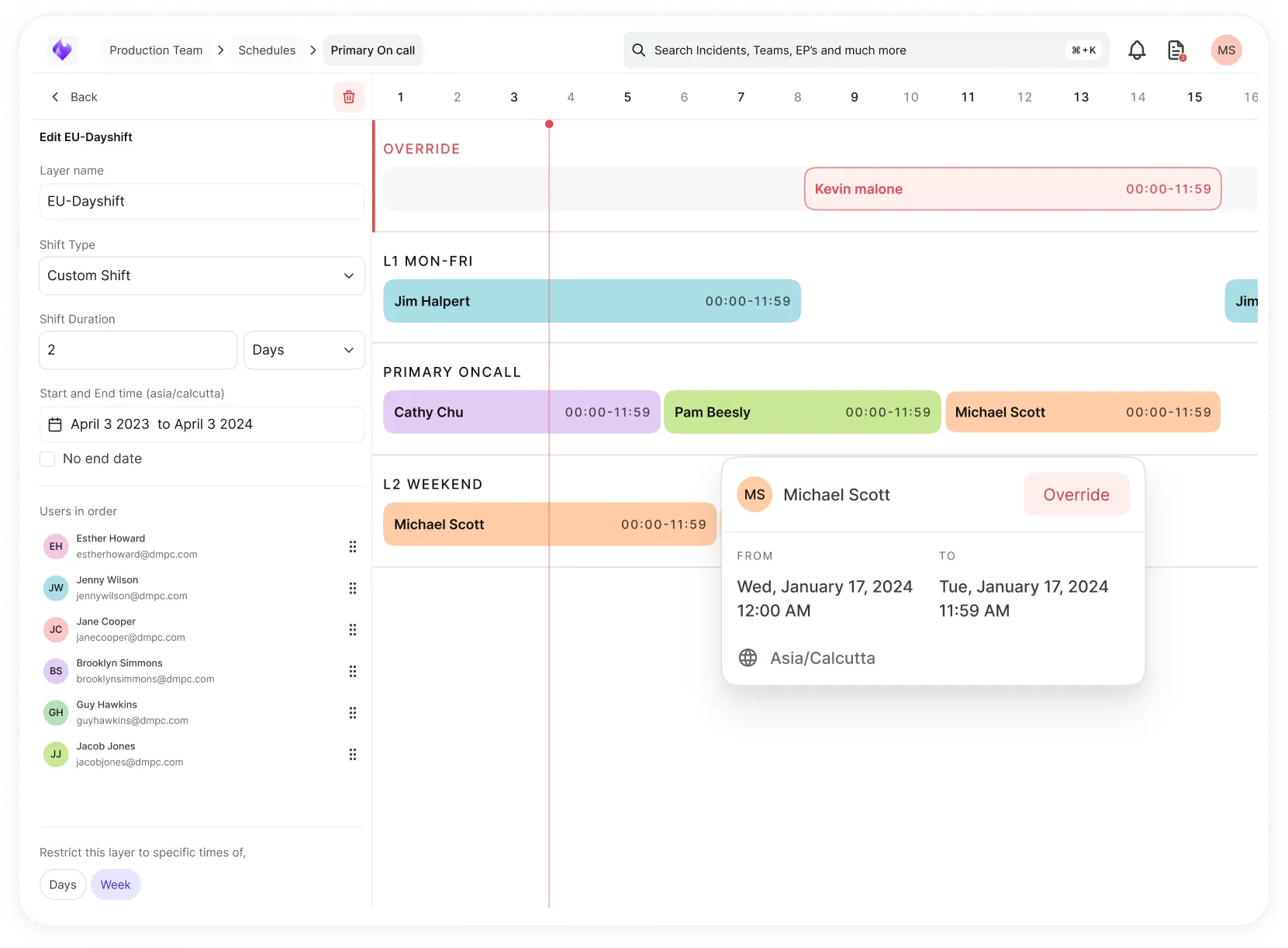
Simplify on-call scheduling, automate escalations, and reduce burnout.
Automate postmortems, AI summaries, and post-incident workflows
Create, organize, and continuously improve your knowledge base to find the right answers with Sera AI.
We're here to help

Discover assets and keep your CMDB accurate, from any source.

Unified IT operations and service management

AI-powered ITSM for the Modern Enterprise

AI-native Incident Management for the Modern Enterprise

Communicate service health in real time

Integrate Xurrent with your full stack

The integration with Atlassian Jira using the Xurrent Integration Service is

The integration with Atlassian Jira using the Xurrent Integration Service is

The integration with Atlassian Jira using the Xurrent Integration Service is

The integration with Atlassian Jira using the Xurrent Integration Service is
The integration with Atlassian Jira using the Xurrent Integration Service is

The integration with Atlassian Jira using the Xurrent Integration Service is

The integration with Atlassian Jira using the Xurrent Integration Service is

The integration with Atlassian Jira using the Xurrent Integration Service is
Resolve issues quickly with an AI-powered system that automates ticketing.
Unifiy IT, HR, Facilities, Finance, and more on a single, AI-powered service platform.
Simplify on-call scheduling, automate escalations, and reduce burnout.
Automate postmortems, AI summaries, and post-incident workflows
Create, organize, and continuously improve your knowledge base to find the right answers with Sera AI.
Resolve plant floor and IT issues before they disrupt production.
Stay audit-ready while resolving issues and reducing operational risk.

Detect, respond, and resolve incidents fast to cut downtime and MTTR.

Keep your store online, even during your biggest sales moments.

Protect patient data and resolve issues fast, so care teams stay focused on care.

Standardize service delivery across every store and channel.

We are here to help 24/7

Connect with other Xurrent Users

Get insights and tips on how to get the most out of Xurrent

Apps, APIs, and updates

Xurrent service functionality

Eliminate manual tasks, optimize workflows, and deliver faster resolutions.
Learn how organizations have reduced downtime, improved 50% MTTA & MTTR, and cut costs with Xurrent IMR.
Discover Xurrent IMR's quick support, bidirectional integrations with Jira and Slack, and more cohesive incident response capabilities compared to Opsgenie.
Understand why users value Xurrent IMR for its intuitive interface, efficient incident alerting, customizable On-call schedules, and escalations.
If frontier models can already reason through an outage, why is every observability vendor building its own specialized AI SRE agent?
The argument was simple. Give a general-purpose agent the right tools, query access and a map of your services, and it can do most of an investigation. Reasoning is a commodity now. What agents lack is an up-to-date picture of the system: which services depend on which, how metrics, logs and traces line up in time, and how a symptom travels back to its cause.
The replies were better than the post. An engineer from a 20-year-old observability vendor (he called himself a "Dynosaur") explained how they pull dependencies out of traces and run plain deterministic anomaly detection before any AI gets involved. The founder of Netdata said that handing a model a compact bundle of the most anomalous metrics changed their results overnight. And an engineer building an AI SRE startup wrote the line that stuck with me: "Almost every bad RCA we've had was a context issue."
That matches what we hear from on-call teams. Nobody complains that the model can't reason. They complain that it blamed the wrong service, and sounded completely sure about it.
So is the problem the agent, or what the agent can see? The research has a surprisingly clear answer.
In early 2025, researchers from Microsoft, CUHK-Shenzhen and Tsinghua published OpenRCA, a benchmark of 335 real failures from three enterprise systems, with 68 GB of logs, metrics and traces behind them. They gave the best models of the time an agent that could write and run code over that telemetry. The top performer, Claude 3.5, found the full root cause in 11.34% of cases.
Models have improved since. A self-reported 2026 score puts Claude Opus 4.6 at about 35% on the same benchmark. That's real progress, and still a long way from "commoditized."
The more useful result came out this year from Zhejiang University and China Telecom Cloud. Their framework, EviRCA, kept the models and changed what the models were given. A deterministic layer first turns raw telemetry into a small set of evidence cards: this component, this anomaly, this onset time. The model then reasons over those cards through a few read-only tools. It never reads raw telemetry and never writes code.
Here's what changed:
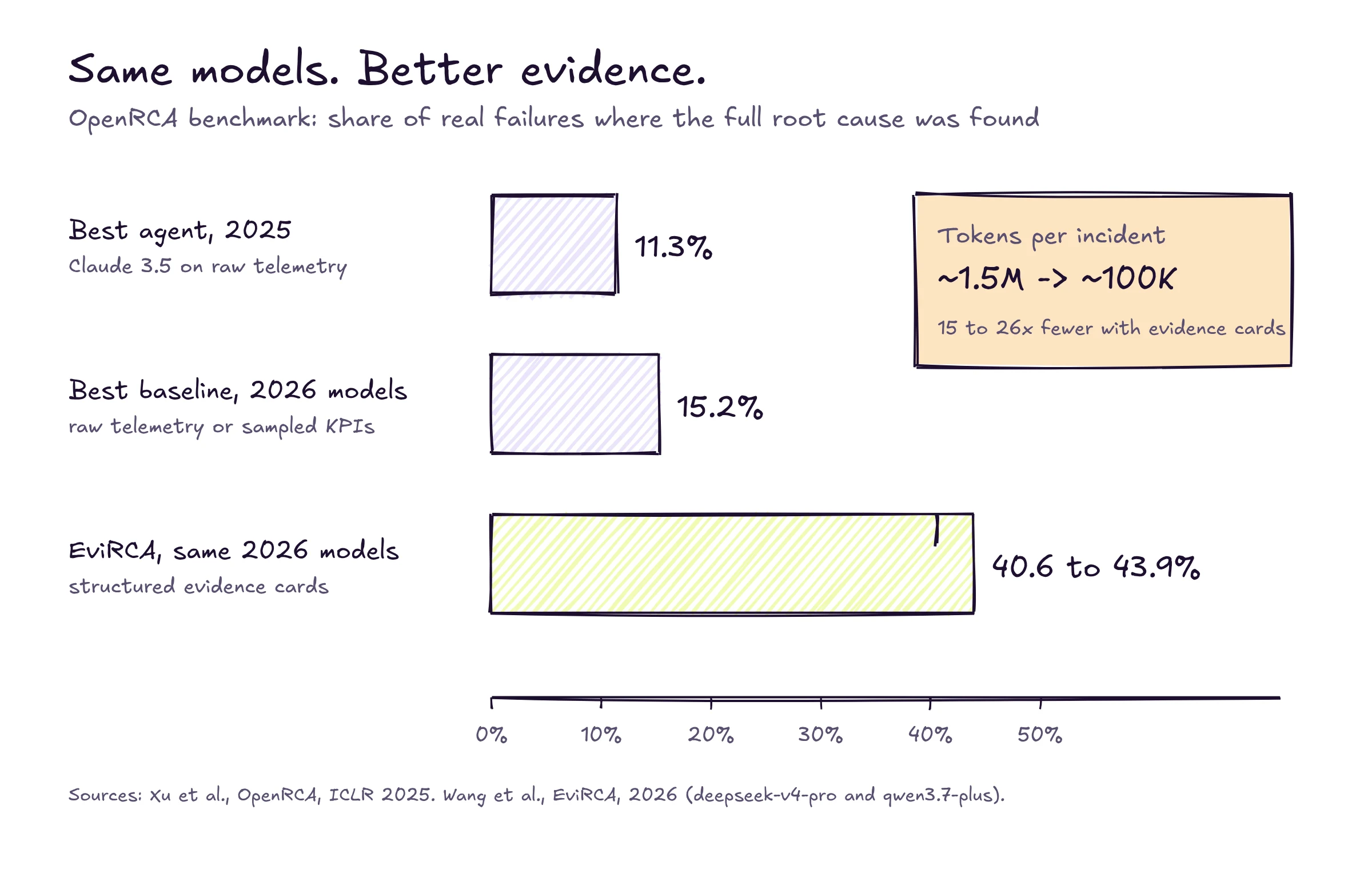
That last finding is the one to sit with. Accuracy moved when the evidence changed. Changing the model barely moved it.
So the original poster was half right. Reasoning is no longer the hard part. An agent still needs something good to reason over, and a general-purpose agent pointed at raw telemetry rarely gets it.
Read enough agent traces and the failures stop looking random. They fall into four buckets, and none of them is "the model wasn't smart enough."
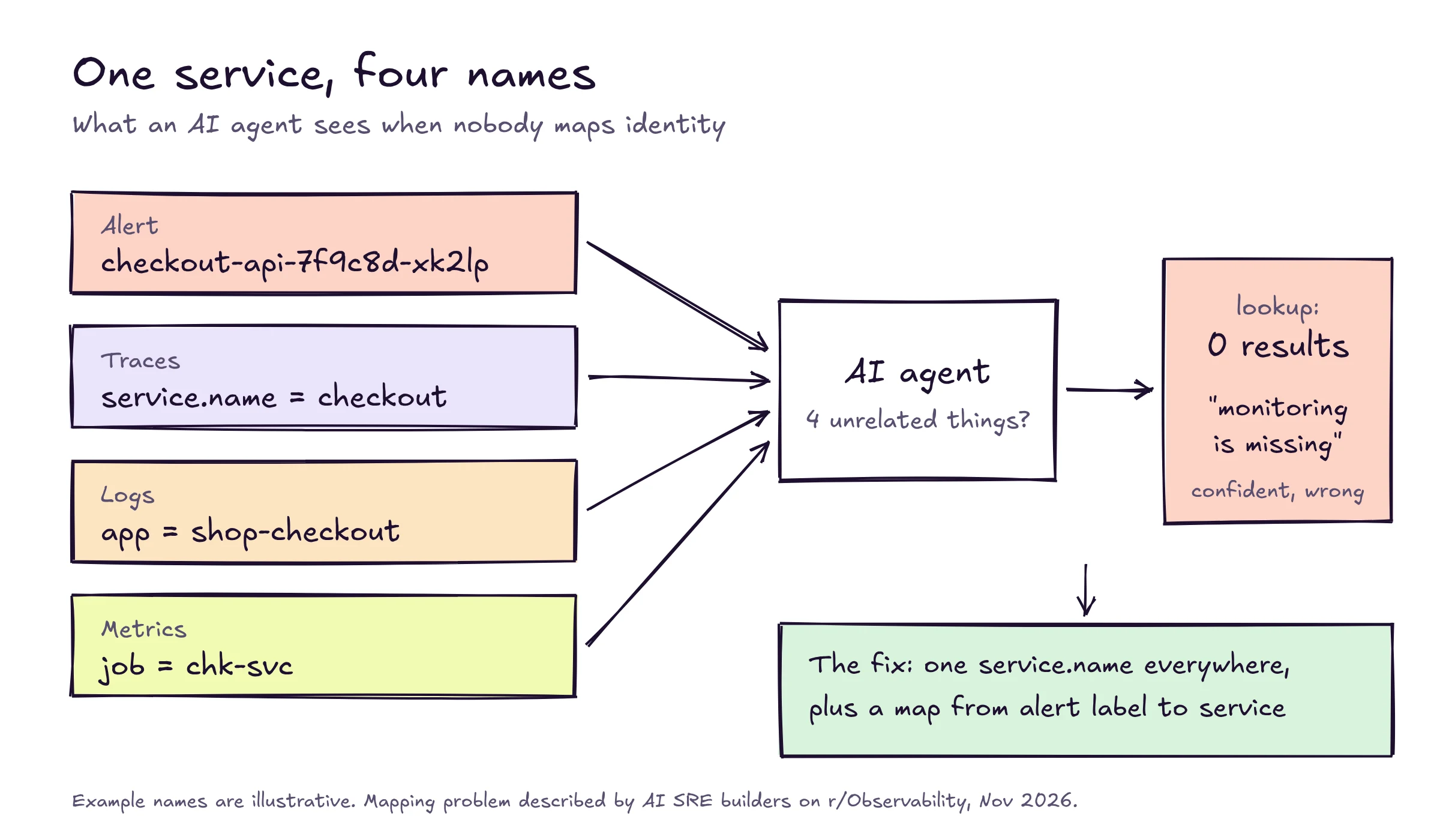
The startup engineer in the thread described it well. The pod name in the alert didn't match the service name in the traces, so the dependency lookup came back empty.
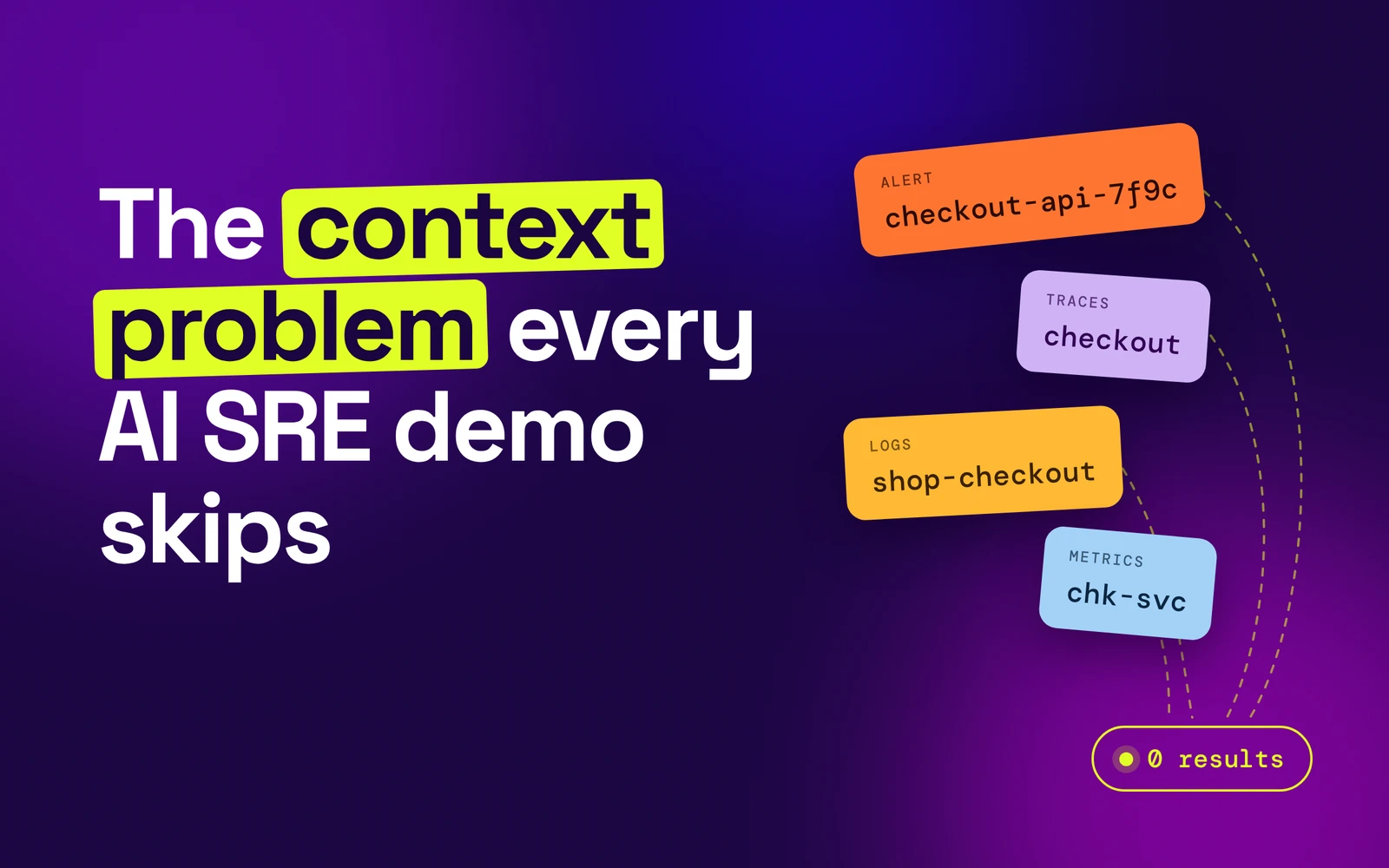
Picture one checkout service with four identities. The alert says checkout-api-7f9c8d-xk2lp. Traces say checkout. Logs say shop-checkout. The metrics job is chk-svc. A senior engineer joins those up in two seconds from memory. An agent sees four unrelated things.
OpenTelemetry tries to fix this by making service.name a required resource attribute. When nobody sets it, the SDK falls back to something like unknown_service:bash. Plenty of production telemetry still looks exactly like that.
In the same thread: a label filter matched zero series, and the model blamed "missing monitoring" with full confidence.
This is the most common failure in the research too. University of Waterloo researchers ran 48,000 simulated failure scenarios across six models, and the two most frequent reasoning failures were fabricated evidence and evidential insufficiency. The paper won a Distinguished Paper Award at FORGE 2026, and its authors found that adding more agentic complexity often made errors worse.
"No data" and "no problem" are different answers. Agents blur them all the time.
Every on-call engineer knows this one. Checkout is screaming because payments is slow. The service with the biggest anomaly is usually the victim.
Agents fall for it constantly. In EviRCA's failure analysis, the single most common miss (35% of single-fault failures) was choosing a downstream component with a stronger anomaly over the real root cause. The Waterloo taxonomy has its own label for it: confusing symptom observers with root-cause sources. Without knowing which way dependencies run, an agent picks whoever is shouting.
The best line in the thread was about knowledge nobody can mine from telemetry: "this metric looks scary but it's normal on standbys," or "this counter is per thread so don't sum it." Someone has to write that down.
Sanjeev Sharma, Field CTO at StackGen, spent a day with senior SREs in Bengaluru and wrote it up for CNCF. He calls this kind of knowledge "people putty": tribal memory held by a few engineers, plus runbooks that go stale after the next infra change. His warning is worth repeating. Stale runbooks can be worse than none, because they invite confident, wrong action.
ClickHouse put the data version of this more bluntly in its AI SRE architecture piece: if your logs only remember two weeks, so does your AI SRE.
Sharma's framing is the cleanest one I've seen. Every real incident decision sits across four bodies of truth:
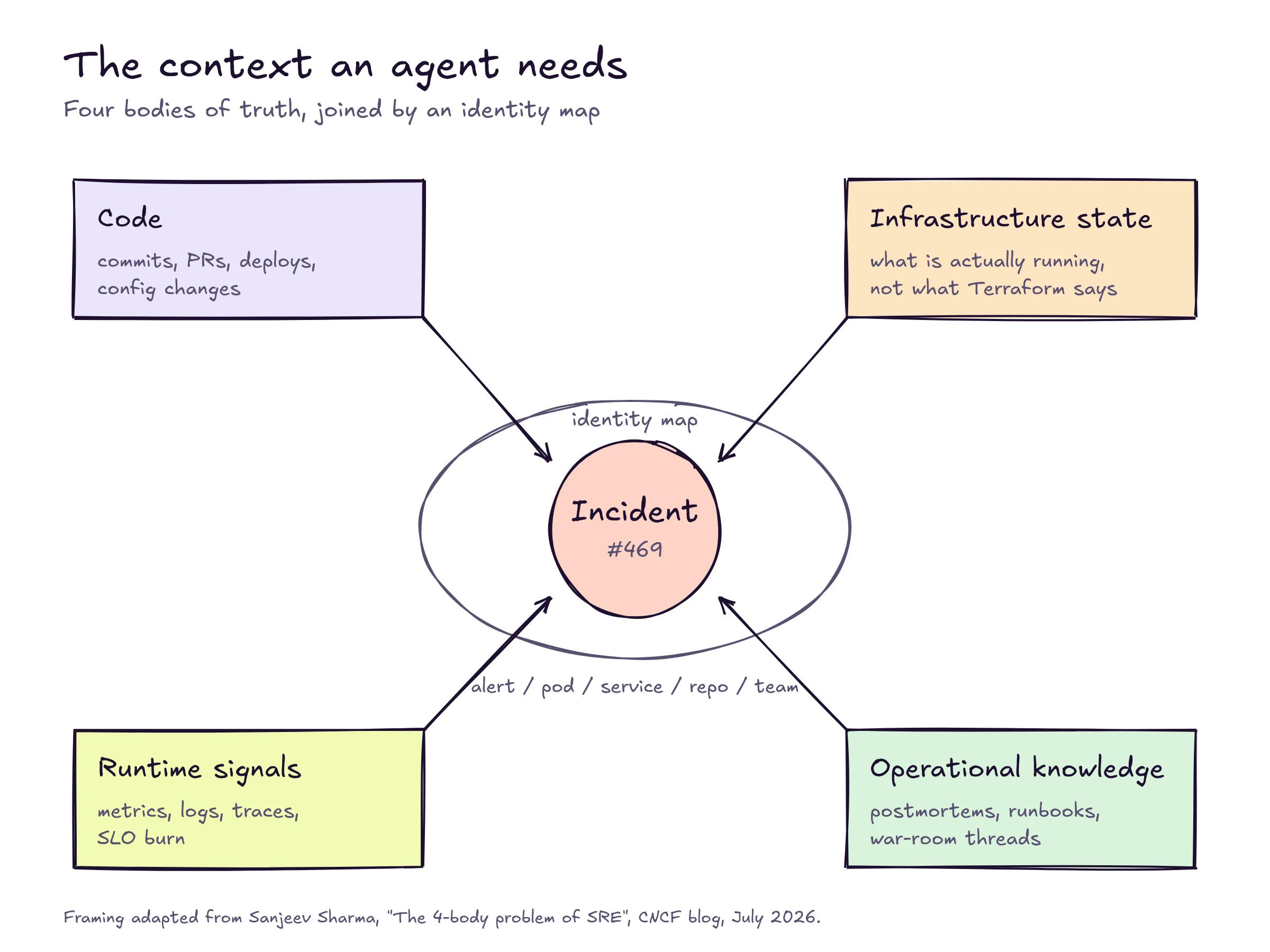
Each one is mostly solved on its own. Git, Terraform, your observability stack and Confluence all work. The trouble is the edges between them, and every incident decision lives on those edges.
I'd add one more piece that holds the other four together: an identity map. Alert label to pod, pod to trace service, trace service to log stream and metric job, then to the repo and the team that owns it. Without that map the four bodies can't be joined, and the agent goes back to guessing.
The four bodies aren't equally hard. Change data is easy to reach and pays off fast, because so many incidents start with a deploy. Runtime signals are there for most teams, and the question is retention and cardinality. Infrastructure state drifts. Operational knowledge is the hardest by far, because it only exists if someone writes it down after an incident.
One warning before anyone builds a data lake for their agent. More context is not the same as better context. A recent DZone session on context precision made the case that piling irrelevant telemetry into a model buries the causal signal, and that a struggling agent will often produce a root cause anyway just to satisfy the prompt. EviRCA's 15 to 26 times token reduction points the same way. The win comes from the right evidence, picked well.
The original poster's real proposal was this: system context should be kept by an independent infrastructure layer that any compatible agent can query, instead of every vendor's agent rebuilding it from scratch mid-incident.
Parts of that are already happening. OpenTelemetry's semantic conventions give everyone a shared vocabulary for services and resources. Service catalogs hold ownership. Protocols like MCP mean a general-purpose agent can query your tools directly, so a vendor's built-in agent is no longer the only way in. The startup engineer in the thread said the one thing he'd fully back is a shared mapping from alert to pod to trace service to log stream to metric job. Half his team's bad RCAs, he wrote, came down to "which thing is this."
The vendors pushed back in useful ways. The engineer from the long-time observability vendor pointed out that platforms already derive dependencies and anomalies deterministically. Teams reach for outside agents because of data the platform doesn't hold: the code base, the change log, the internal knowledge base. The startup engineer added that a topology graph tells you what talks to what, but nothing in the telemetry will ever tell you a metric is normal on standbys.
Here's where I land. Split context by where it's born.
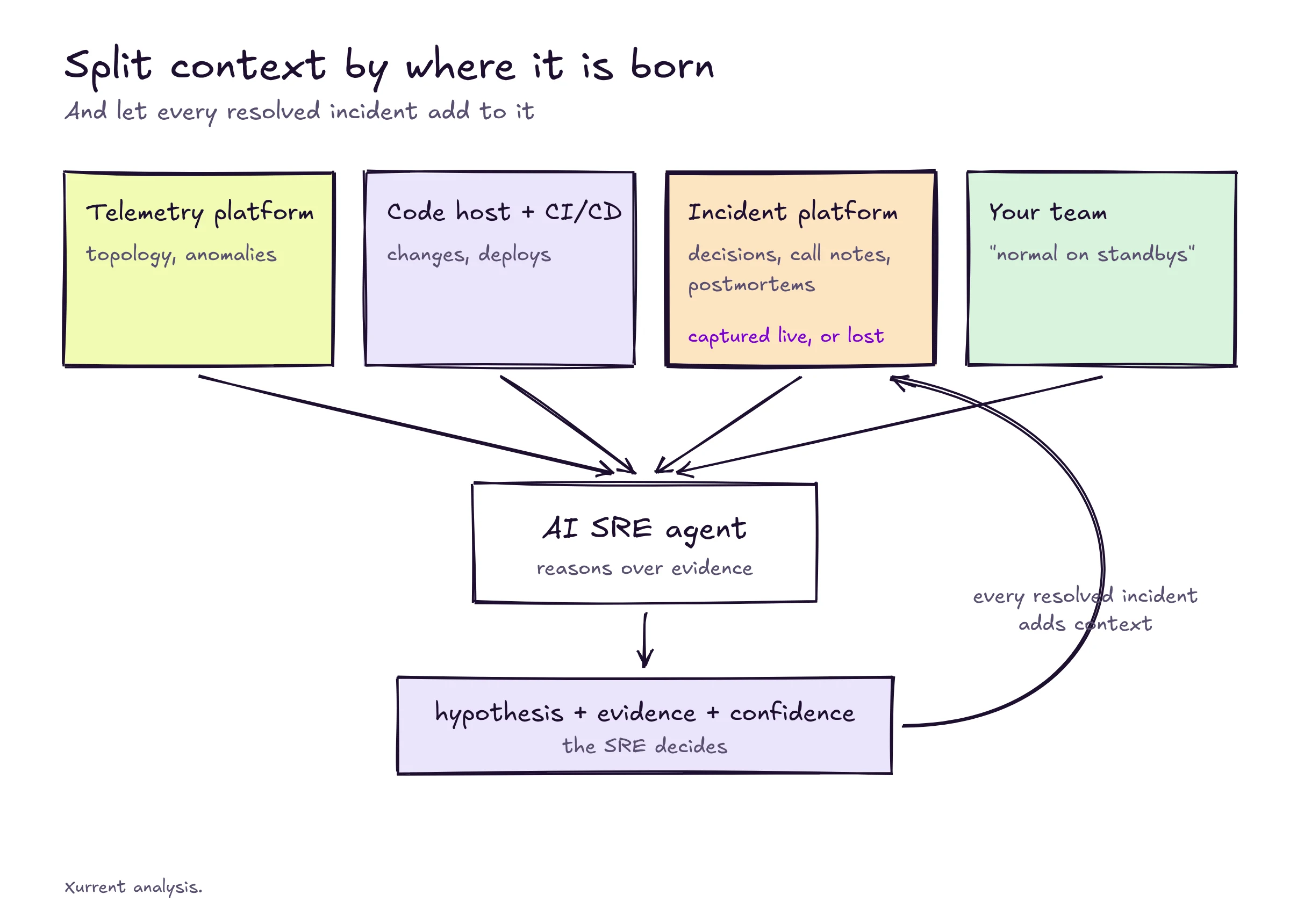
That last layer is the one nobody can rebuild after the fact. If it isn't captured while the incident is happening, it's gone, and the next agent starts from zero.
The poster also floated a feedback loop, where what an RCA investigation learns flows back into the shared context. That's the part I'd bet on. Every resolved incident should leave the context a little better than it found it.
Whether you're evaluating a vendor or wiring up your own agent, most of the work is the same. In rough order of payoff:
service.name and service.namespace everywhere, and make sure alert labels map back to them. This one fix clears up more bad RCAs than any model upgrade, according to the people building these agents.Sharma's CNCF piece adds one more: keep a decision trace. For anything an agent does, record what it saw, which model ran, what it considered and rejected, and what happened. The first time an agent does something surprising in production, someone will ask for exactly that.
We built Sera, the AI SRE teammate inside Xurrent IMR, around the layer this thread kept circling back to: what your team already knows.
When an alert fires, Sera Investigate starts from the alert payload: service, error type, severity, thresholds. It finds the most similar incidents your team has resolved, reads their postmortems, engineer notes and war-room threads, and checks recent GitHub changes against the incident timeline. What comes back is a probable root cause, a confidence level, the evidence behind it, and links to the exact PR and line when a change looks responsible. When the evidence is thin, it says so.
To be clear about scope: Sera doesn't query your observability tools directly today. It works from what the alert carries plus your incident and change history. Connecting more of the stack is on the roadmap, and we'd rather tell you that than overclaim.
The memory side is where it compounds. Sera Scribe takes notes on the incident call, and Sera Postmortems drafts the review from the incident record. Your team edits and publishes it. That postmortem becomes evidence for the next investigation, so operational knowledge gets written down while the incident is still fresh instead of living in two people's heads.
It also lives where the work happens: Slack, Microsoft Teams and Google Chat, plus inside Claude through MCP. That last one is a small version of the shared-context idea from the thread. Your incident history becomes something any compatible agent can ask about.
The SRE still makes every call. Sera hands them a hypothesis with its evidence attached, before they've finished reading the alert. If you want the longer version of how it works, read An AI SRE that knows your incidents.
As tech grows more dynamic, SRE (Site Reliability Engineering) teams constantly seek smarter, more efficient tools to manage incidents and alerts. Explore top 9 PagerDuty alternatives for 2024. Compare features, pricing, and benefits to find the best fit for your incident management needs.
As tech grows more dynamic, SRE (Site Reliability Engineering) teams constantly seek smarter, more efficient tools to manage incidents and alerts. Explore top 9 PagerDuty alternatives for 2024. Compare features, pricing, and benefits to find the best fit for your incident management needs.