





Blog
Insights & updates from our experts


Resolve plant floor and IT issues before they disrupt production.

Stay audit-ready while resolving issues and reducing operational risk.
Resolve issues quickly with an AI-powered system that automates ticketing.
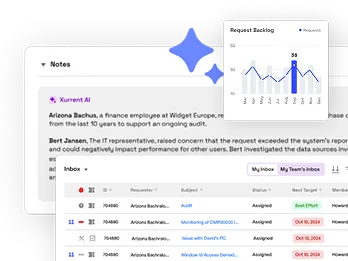
Unifiy IT, HR, Facilities, Finance, and more on a single, AI-powered service platform.
Simplify on-call scheduling, automate escalations, and reduce burnout.
Automate postmortems, AI summaries, and post-incident workflows
Create, organize, and continuously improve your knowledge base to find the right answers with Sera AI.
We're here to help

The integration with Atlassian Jira using the Xurrent Integration Service is

The integration with Atlassian Jira using the Xurrent Integration Service is

The integration with Atlassian Jira using the Xurrent Integration Service is

The integration with Atlassian Jira using the Xurrent Integration Service is

The integration with Atlassian Jira using the Xurrent Integration Service is

The integration with Atlassian Jira using the Xurrent Integration Service is

The integration with Atlassian Jira using the Xurrent Integration Service is

The integration with Atlassian Jira using the Xurrent Integration Service is
Resolve issues quickly with an AI-powered system that automates ticketing.
Unifiy IT, HR, Facilities, Finance, and more on a single, AI-powered service platform.
Simplify on-call scheduling, automate escalations, and reduce burnout.
Automate postmortems, AI summaries, and post-incident workflows
Create, organize, and continuously improve your knowledge base to find the right answers with Sera AI.
Resolve plant floor and IT issues before they disrupt production.
Stay audit-ready while resolving issues and reducing operational risk.

Detect, respond, and resolve incidents fast to cut downtime and MTTR.

Keep your store online, even during your biggest sales moments.

Protect patient data and resolve issues fast, so care teams stay focused on care.
Standardize service delivery across every store and channel.

We are here to help 24/7

Connect with other Xurrent Users

Get insights and tips on how to get the most out of Xurrent

Apps, APIs, and updates

Xurrent service functionality

Eliminate manual tasks, optimize workflows, and deliver faster resolutions.
Learn how organizations have reduced downtime, improved 50% MTTA & MTTR, and cut costs with Xurrent IMR.
Discover Xurrent IMR's quick support, bidirectional integrations with Jira and Slack, and more cohesive incident response capabilities compared to Opsgenie.
Understand why users value Xurrent IMR for its intuitive interface, efficient incident alerting, customizable On-call schedules, and escalations.
Your support team is drowning in emails, chat messages, and phone calls scattered across five different tools—and somehow, tickets still fall through the cracks. Meanwhile, your engineers are getting paged for issues that could have been resolved with a simple knowledge base article.
Help desk solutions exist to solve exactly this problem by centralizing every support request into one system where nothing gets lost and the right person handles each issue. This guide breaks down 45 platforms across every category—from free tools for small IT teams to enterprise service desks that unify operations across your entire organization—so you can find the one that actually fits how your team works.
Help desk software is a centralized system for managing support requests—called tickets—from customers or employees through email, chat, phone, and web forms. Popular platforms like Zendesk, Freshdesk, and ServiceNow automate workflows, track performance, and include knowledge bases for self-service. Options range from free tools like Spiceworks to advanced, AI-powered enterprise platforms.
Every help desk has three core components. First, a ticketing system organizes and assigns work. Second, a knowledge base lets users find answers on their own. Third, reporting tools show how quickly your team responds and resolves issues.
Some platforms focus only on external customer support. Others—often called service desks—take a broader approach that includes change management, asset tracking, and ITIL-aligned workflows for internal IT operations.
The biggest decision is whether you're supporting employees or customers. Internal IT teams typically want ITSM capabilities like asset management, change control, and incident escalation. Customer support teams care more about omnichannel communication, satisfaction tracking, and CRM integration.
A few questions worth asking:
Your help desk won't operate in isolation. CRM systems like Salesforce or HubSpot provide customer context. Communication tools like Slack or Microsoft Teams enable real-time collaboration. For IT teams, monitoring platforms can connect alerts directly to tickets.
A platform that works for 10 agents might struggle at 100. Think about whether the solution supports multi-department expansion, international support needs, and flexible agent seat limits without dramatic price jumps.
Healthcare, finance, and government organizations have specific compliance requirements. Look for SOC 2, ISO 27001, GDPR, and HIPAA certifications depending on your industry. Data residency—where your data is physically stored—matters for organizations operating under regional data protection laws.
Per-agent pricing tells only part of the story. Factor in implementation costs, training time, customization requirements, and ongoing administration. Some platforms require dedicated administrators and external consultants, while others are designed for lean teams to manage independently.
Tickets are the fundamental unit of work in any help desk. Effective platforms automatically route incoming requests based on category, priority, or agent skills. This reduces manual triage and gets the right person working on each issue faster.
When users find answers on their own, ticket volume drops and satisfaction rises. A well-maintained knowledge base handles routine questions like password resets or policy lookups without requiring agent involvement.
Omnichannel support means managing phone, email, live chat, social media, and web forms from a single view. Agents see the complete conversation history regardless of which channel the customer used, so nobody has to repeat themselves.
Key metrics include MTTA (Mean Time to Acknowledge), which measures how quickly agents respond initially, and MTTR (Mean Time to Resolve), which tracks end-to-end resolution speed. CSAT (Customer Satisfaction) scores reveal the quality of the support experience.
Automation handles repetitive tasks like ticket assignment, status updates, and escalation triggers. This frees agents to focus on complex issues that require human judgment.
Service Level Agreements define your commitment to response and resolution times. Help desk tools track SLA compliance automatically and alert teams before breaches occur.
AI in help desk software has evolved beyond basic chatbots. Intelligent ticket routing analyzes incoming requests to categorize, prioritize, and assign them automatically—often more accurately than manual triage.
AI-powered virtual agents handle routine inquiries without human intervention. The difference between rule-based bots and true AI agents is significant: one follows scripts, the other learns and adapts based on context.
Predictive analytics identify patterns that help prevent issues before they generate tickets. For example, detecting service degradation trends before users start reporting problems.
Platforms like Xurrent embed AI as a core layer—called AI Fabric—rather than offering it as an add-on feature. This approach enables continuous improvement across routing, automation, and decision support throughout the entire platform.
Hidden costs to watch for include implementation fees, premium support charges, and integration costs. Some vendors offer transparent pricing while others require sales conversations for quotes.
Xurrent brings ITSM, IT operations, and incident management together in a single platform. Rather than stitching together separate tools for each function, Xurrent provides a shared operational fabric where service desks, SREs, DevOps teams, and business teams work from the same data.
The AI Fabric operates continuously across the platform—improving routing, automation, and decision support over time. Zero-trust security and built-in compliance support for SOC 2, ISO, and ITIL make it suitable for security-conscious organizations.
Schedule a demo to see unified service management in action →
Freshservice delivers modern IT service desk capabilities with an intuitive interface and ITIL-ready workflows. AI-powered ticket routing and a clean user experience make it accessible for mid-market organizations seeking cloud-based ITSM without heavy implementation overhead.
Freshdesk focuses on customer-facing support with collaborative ticketing, omnichannel capabilities, and automation features. It's distinct from Freshservice—Freshdesk handles external customers while Freshservice serves internal IT.
Zendesk remains the industry standard for customer experience platforms, offering robust multichannel support, an extensive marketplace of integrations, and sophisticated analytics. It's best suited for CX-focused teams rather than internal IT operations.
ServiceNow dominates enterprise ITSM with comprehensive workflow automation, asset tracking, and change management. However, the platform's complexity typically requires dedicated administrators and longer implementation timelines.
For organizations already using Atlassian products, Jira Service Management provides strong incident and change management capabilities with native integration to Jira Software. Engineering and DevOps teams often find the familiar interface reduces adoption friction.
Small teams prioritize ease of setup, affordable pricing, and essential features without overwhelming complexity. Tools like Freshdesk, Help Scout, Hiver, and Spiceworks offer shared inbox functionality and straightforward ticketing without requiring dedicated administrators.
Enterprise organizations look for scalability, advanced workflows, compliance certifications, and deep integration capabilities. Platforms like ServiceNow, Xurrent, and Salesforce Service Cloud support complex multi-department operations, though they typically require longer implementation timelines.
For regulated industries, security capabilities often determine which platforms make the shortlist:
Xurrent's zero-trust security model assumes no user or system is inherently trusted, requiring continuous verification for every interaction.
The right help desk platform unifies service workflows rather than adding another disconnected tool to your stack. Start by clarifying whether you're primarily supporting internal employees or external customers, then evaluate integration requirements, scalability needs, and security standards.
Organizations dealing with fragmented toolchains—where incidents slow down as work moves between disconnected systems—often benefit from platforms designed to bring service, operations, and incident management together.
Schedule a demo with Xurrent to see how a unified approach transforms service delivery across IT and business teams.

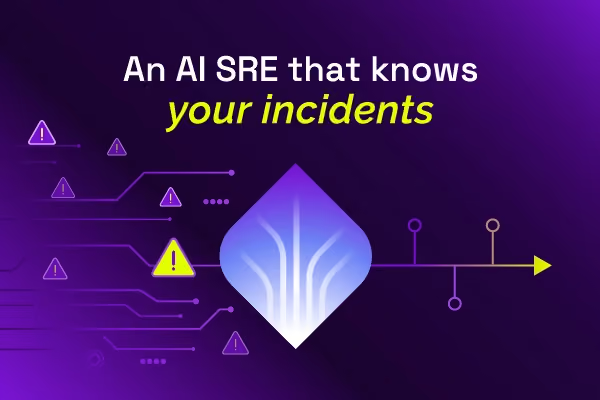
Most AI SREs are pattern matchers trained on public data. They know what a memory leak looks like in the abstract. They don't know that your payments-api has a flaky liveness probe everyone ignores, that the checkout team owns the retry policy, or that the last three "database incidents" were actually cache misconfigurations. That knowledge lives in your postmortems, your Slack channels, and the heads of two senior engineers.

.avif)