




Blog
Insights & updates from our experts


Resolve plant floor and IT issues before they disrupt production.

Stay audit-ready while resolving issues and reducing operational risk.
Resolve issues quickly with an AI-powered system that automates ticketing.
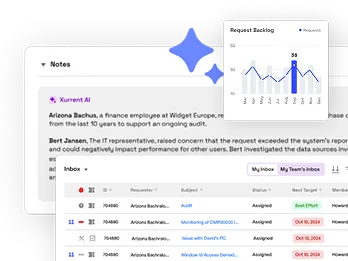
Unifiy IT, HR, Facilities, Finance, and more on a single, AI-powered service platform.
Simplify on-call scheduling, automate escalations, and reduce burnout.
Automate postmortems, AI summaries, and post-incident workflows
Create, organize, and continuously improve your knowledge base to find the right answers with Sera AI.
We're here to help

The integration with Atlassian Jira using the Xurrent Integration Service is

The integration with Atlassian Jira using the Xurrent Integration Service is

The integration with Atlassian Jira using the Xurrent Integration Service is

The integration with Atlassian Jira using the Xurrent Integration Service is

The integration with Atlassian Jira using the Xurrent Integration Service is

The integration with Atlassian Jira using the Xurrent Integration Service is

The integration with Atlassian Jira using the Xurrent Integration Service is

The integration with Atlassian Jira using the Xurrent Integration Service is
Resolve issues quickly with an AI-powered system that automates ticketing.
Unifiy IT, HR, Facilities, Finance, and more on a single, AI-powered service platform.
Simplify on-call scheduling, automate escalations, and reduce burnout.
Automate postmortems, AI summaries, and post-incident workflows
Create, organize, and continuously improve your knowledge base to find the right answers with Sera AI.
Resolve plant floor and IT issues before they disrupt production.
Stay audit-ready while resolving issues and reducing operational risk.

Detect, respond, and resolve incidents fast to cut downtime and MTTR.

Keep your store online, even during your biggest sales moments.

Protect patient data and resolve issues fast, so care teams stay focused on care.

Standardize service delivery across every store and channel.

We are here to help 24/7

Connect with other Xurrent Users

Get insights and tips on how to get the most out of Xurrent

Apps, APIs, and updates

Xurrent service functionality

Eliminate manual tasks, optimize workflows, and deliver faster resolutions.
Learn how organizations have reduced downtime, improved 50% MTTA & MTTR, and cut costs with Xurrent IMR.
Discover Xurrent IMR's quick support, bidirectional integrations with Jira and Slack, and more cohesive incident response capabilities compared to Opsgenie.
Understand why users value Xurrent IMR for its intuitive interface, efficient incident alerting, customizable On-call schedules, and escalations.

4 service desk tools. One long search for the right one.
Since SETCOR first deployed ManageEngine ServiceDesk Plus more than 15 years ago, it has been refining how it runs IT support.
ManageEngine gave way to BMC Remedy.
BMC Remedy gave way to Jira Service Management.
Each tool made sense at the time. Each one eventually ran out of road.
The 35-year-old Croatian IT company, headquartered in Zagreb, operates its own data centers — delivering Infrastructure as a Service and ISP connectivity to 570 external customers. Roughly 40 engineers, including a 15-person 24/7 support team, keep that operation running around the clock.
For a company like this, an ITSM platform isn’t a productivity tool. It’s the system of record for everything they sell.
Attempt #4 — Xurrent — is where the search ended.
Platform #1, ManageEngine ServiceDesk Plus, worked when SETCOR’s team was small. It stopped working when the company began pursuing ISO 9000 and ISO 20000 certifications, and the modules required for those standards weren’t there.
Platform #2, BMC Remedy (deployed with longtime partner Imaves d.o.o aka Imaves), solved the certification gap. But … it was over-engineered for a 40-engineer shop, and the implementation alone took 6 to 9 months.
Platform #3, Jira Service Management … customizable, fast, and far cheaper to run. The catch was that almost every meaningful capability lived behind a separate plugin, each with its own license fee and configuration burden.
As Siniša Sabljić, Head of Technical Support Department, SETCOR, shared, "If you needed additional functionality, you often had to choose between multiple plugins, each with its own licensing and configuration overhead. With that many plugins layered on top, the configuration was no longer very intuitive.
Each platform had its own issues, but one pattern persisted across all 3, as Matija Šinogl, Director of the Information Technology Department at SETCOR, shared: “All the other tools before Xurrent were generally a basic asset register. They weren’t service-oriented. We tried to build services using those tools, but it didn’t work.”
Requirements change. Software improves. And a good partner keeps their finger on the market pulse for their clients. For the fourth evaluation, SETCOR turned to Imaves — the partner that had walked them through the BMC Remedy implementation. Based on SETCOR’s latest requirements, Imaves recommended Xurrent. The team also evaluated Jira Cloud as a possible migration path from their on-prem Jira deployment, but the plugin economics didn’t change.
The selection criteria, per Siniša’s read, were specific:
Check. Check. And … check. Xurrent met all three.
As Siniša shared, “Everything is ITIL-based — that was the main reason we chose Xurrent and not Jira.”
For Matija, the structural difference was sharper:
“Xurrent is the first tool where assets are actually configured as services, and we can do it easily. For me, that is the biggest difference compared to the other tools.”
The implementation kicked off in spring 2024. By June 1, the team was live in production.
“Once they decided that Xurrent was the right solution, it took a very relaxed two months to reach production. SETCOR is a mature organization, and both Siniša and Matija are very experienced, which certainly helped.” — Zoran Habijan, CEO of Imaves
The work happened across roughly 10 to 15 working sessions. By the end, SETCOR had migrated:
For context, its BMC Remedy rollout took 6 to 9 months.
Go-live itself was a single two-hour workshop. After it, per Zoran, the team “fully transitioned to the new tool — without any complaints.”
That last part — the silence from a team that had grumbled through three prior migrations — is what stood out most to Siniša:
“It was the first implementation that no one said, ‘This is not good. It was better in Jira.’”
Two years in, what stands out to Siniša isn't the throughput numbers (although they are impressive), but something harder to put on a slide — what he calls "the discipline of working with requests" [...] "The request is not getting lost. It's always on the dashboard."
What that looks like in practice:
Tickets stop getting lost. Every request lands on the correct dashboard, attached to the correct customer, with the correct SLA. Clean handoffs are enforced by the system. Registered and completed request counts track nearly 1:1 month over month — the backlog essentially doesn't exist.
AI handles email triage. Sera AI now automatically classifies inbound email tickets — currently at 90%+ accuracy — with the team training it via thumbs-down corrections when it misroutes.
Self-service has uptake. Roughly 20% of requests now come through the customer portal. As Matija puts it: "Customers didn't use our self-service portals before. The Xurrent self-service portal is used a lot more than before with the previous tools." Larger customers are now mandating portal use internally.
Customer satisfaction holds near-perfect. Satisfaction scores have run at 97–99% consistently since go-live, with dissatisfied responses rarely exceeding 3 in any given month — across a team handling thousands of requests.
Reporting that the sales team actually uses. Filterable dashboards for time-spent-per-customer, contract expirations, and SLA performance — no Excel exports. No need for extensive training.
“Our teams in the morning just switched to Xurrent, and they were working,” Matija shared. “There was no ‘how do I do that?’ They were just working.”
SETCOR has already begun extending Xurrent beyond IT support — vacation request workflows, internal approval tasks, and business-trip summaries now run through the same platform. The next priority on Matija and Siniša’s roadmap: integrations with the company’s custom-built sales and billing tools.
The team has also become an informal Xurrent reference. SETCOR has already hosted a major Croatian business partner who came specifically to see the platform in action. Imaves continues as the implementation partner — both for the day-to-day and the next phase.
We are thrilled to be a partner as this relationship continues to grow.
Thank you, Matija, Siniša, and Team SETCOR. And to our longtime friends at Imaves — Zoran, Matea, and team — for walking the journey with them.



.webp)
.webp)

.webp)