




Blog
Insights & updates from our experts


Resolve plant floor and IT issues before they disrupt production.

Stay audit-ready while resolving issues and reducing operational risk.
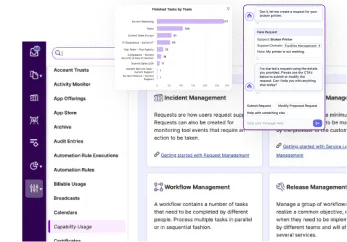
Resolve issues quickly with an AI-powered system that automates ticketing.
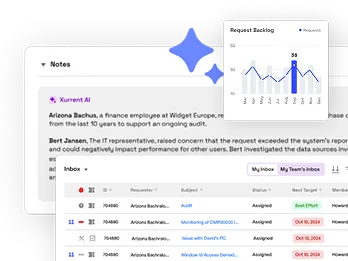
Unifiy IT, HR, Facilities, Finance, and more on a single, AI-powered service platform.
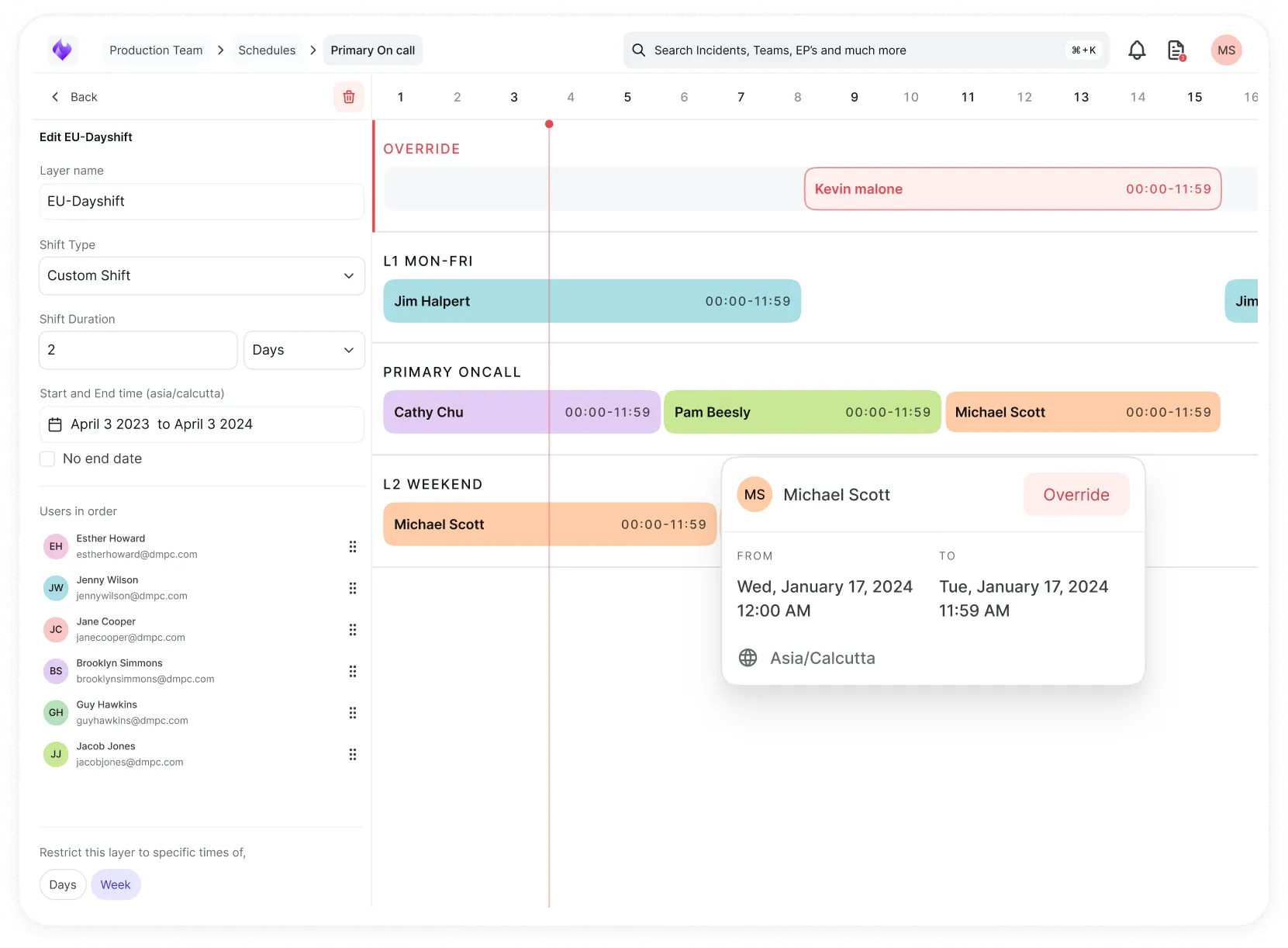
Simplify on-call scheduling, automate escalations, and reduce burnout.
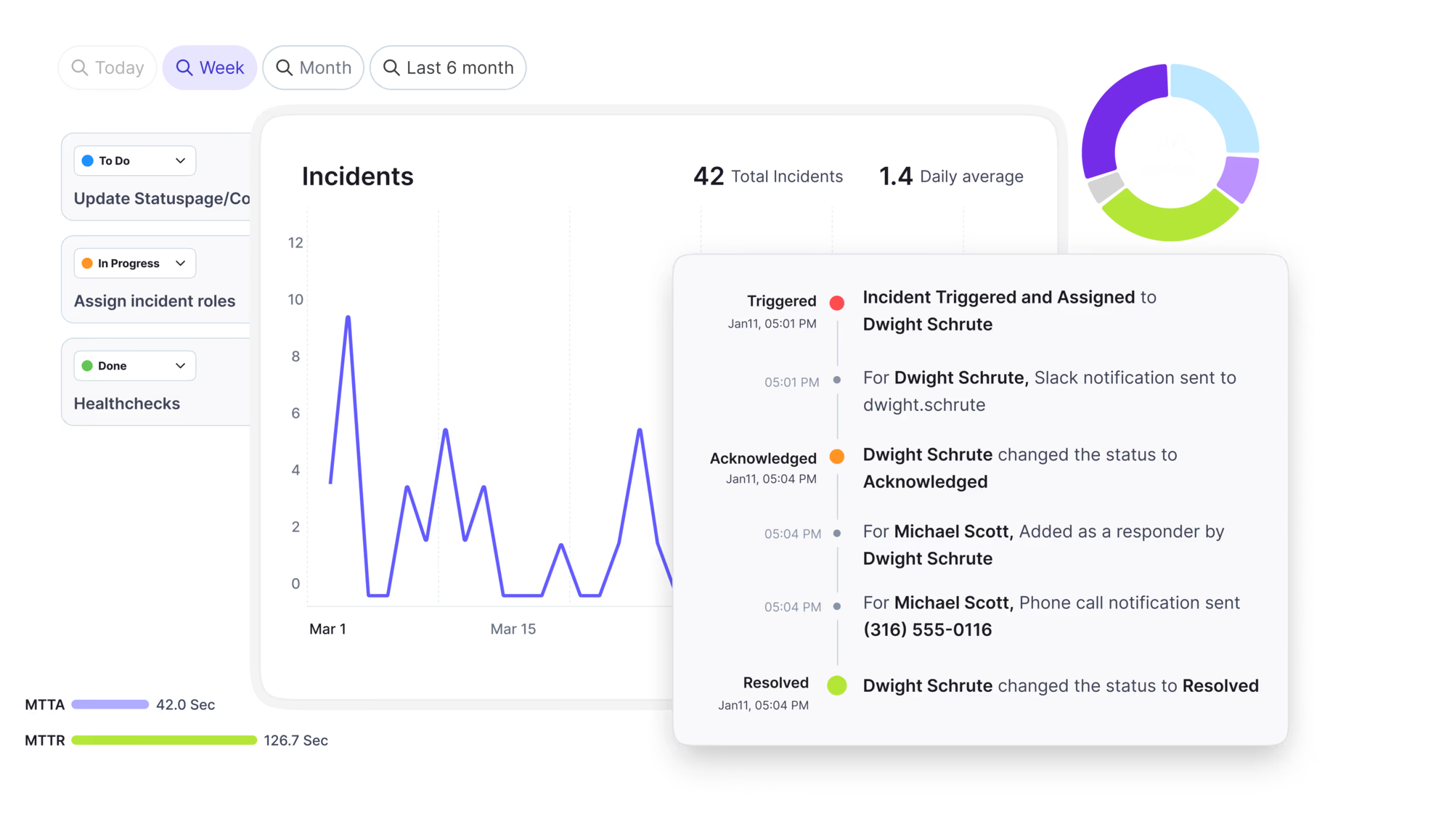
Automate postmortems, AI summaries, and post-incident workflows
Create, organize, and continuously improve your knowledge base to find the right answers with Sera AI.
We're here to help

The integration with Atlassian Jira using the Xurrent Integration Service is

The integration with Atlassian Jira using the Xurrent Integration Service is

The integration with Atlassian Jira using the Xurrent Integration Service is

The integration with Atlassian Jira using the Xurrent Integration Service is

The integration with Atlassian Jira using the Xurrent Integration Service is

The integration with Atlassian Jira using the Xurrent Integration Service is

The integration with Atlassian Jira using the Xurrent Integration Service is

The integration with Atlassian Jira using the Xurrent Integration Service is
Resolve issues quickly with an AI-powered system that automates ticketing.
Unifiy IT, HR, Facilities, Finance, and more on a single, AI-powered service platform.
Simplify on-call scheduling, automate escalations, and reduce burnout.
Automate postmortems, AI summaries, and post-incident workflows
Create, organize, and continuously improve your knowledge base to find the right answers with Sera AI.
Resolve plant floor and IT issues before they disrupt production.
Stay audit-ready while resolving issues and reducing operational risk.

Detect, respond, and resolve incidents fast to cut downtime and MTTR.

Keep your store online, even during your biggest sales moments.

Protect patient data and resolve issues fast, so care teams stay focused on care.

Standardize service delivery across every store and channel.

We are here to help 24/7

Connect with other Xurrent Users

Get insights and tips on how to get the most out of Xurrent

Apps, APIs, and updates

Xurrent service functionality

Eliminate manual tasks, optimize workflows, and deliver faster resolutions.
Learn how organizations have reduced downtime, improved 50% MTTA & MTTR, and cut costs with Xurrent IMR.
Discover Xurrent IMR's quick support, bidirectional integrations with Jira and Slack, and more cohesive incident response capabilities compared to Opsgenie.
Understand why users value Xurrent IMR for its intuitive interface, efficient incident alerting, customizable On-call schedules, and escalations.

UPDATED 11-August-2026
AI in Service Management is evolving … rapidly.
At Xurrent, we believe this transformation should go beyond simply responding to prompts. That sentiment led to the creation of Sera AI, a proactive and intelligent fabric that’s embedded throughout the platform, designed to streamline operations, boost productivity, and help modern enterprises move faster with confidence.
Sera is more than a feature.
We have delivered an AI fabric woven into the core of the Xurrent platform.
Always on.
Always learning.
Always working behind the scenes to make your service desk faster, smarter, and more resilient.
Think of an AI fabric as a network of intelligence that’s embedded across the Service Management platform, not bolted on — a continuous layer of context-aware automation, decision support, and adaptive intelligence. It spans everything from ticket classification and routing to summarization, knowledge recommendations, sentiment analysis, and workflow automation.
Sera AI doesn’t wait to be asked.
It anticipates, recommends, and acts — amplifying the productivity of every user in the system.
Sera AI includes a familiar conversational interface, but its real power is in what it does tirelessly, continuously, and at scale:
These aren’t just vanity metrics. They represent real productivity gains and measurable operational improvements across MSPs and enterprise IT teams already using Xurrent.
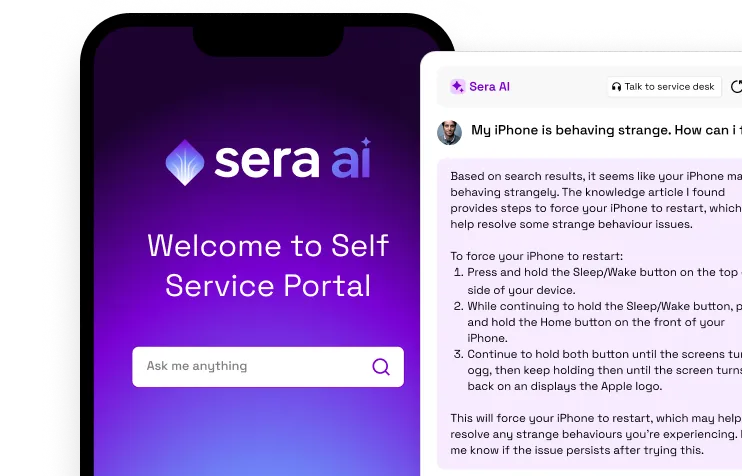
The value of Sera AI lies in its deep integration across the entire Xurrent platform. It does more than react to incoming requests. Even before a ticket is created, end users can interact with Sera to troubleshoot and resolve issues independently. Through intelligent search and contextual recommendations, Sera empowers users to solve problems instantly without needing to contact the service desk.
When a request does enter the system, Sera AI is already in motion — classifying, routing, understanding, and recommending in real time.
The result:
With AI-powered automation across ITSM, ESM, and ITOM, Xurrent drives productivity and efficiency, reducing overhead while meeting full ITIL, SOC-2, C5, and ISO standards.
The Xurrent platform is a complete, cross-functional platform that aligns HR, Facilities, Finance, Marketing, and IT, fostering unified, scalable operations for growth.
AI is an essential part of what we do, the platform we provide to our customers.
As we shared here, Xurrent leverages generative AI models, all housed within AWS Bedrock — in a manner entirely consistent with how we deliver the rest of our technology suite.
Privacy, transparency, and security are front and center of everything we do. AI is no exception.
We respect all existing permissions.
We use AWS as our AI Subprocessor via Bedrock.
We deliver AI transparently.
We clearly share which decisions are made by AI vs humans.
We understand the customer’s problem rather than adding AI for the sake of having AI.
We think seriously about security.*
We do not introduce any new technical cross-section or vector for attack.
We do not store any new data.
We do not retain data for AI.
*Generative AI can be a great productivity tool but can pose a security risk of leaking private information into the public domain. To prevent this situation, Xurrent uses Amazon Bedrock as its generative AI solution.
From the Amazon Bedrock documentation, “Amazon Bedrock doesn’t store or log your prompts and completions. Amazon Bedrock doesn’t use your prompts and completions to train any AWS models and doesn’t distribute them to third parties.”
We’ve built AI around the use cases in which it can deliver value. We’ve optimized for where AI can reduce the burden on humans, saving time and money. Here are a few:
Every feature above works behind the scenes to make specialists faster. Sera Assist brings that intelligence forward into a single panel, where the work happens.
Sera Assist is an AI-powered panel embedded in the specialist experience. When a specialist opens a request, Sera Assist summarizes the issue, surfaces relevant knowledge articles, and suggests next steps. Specialists skip the tab switching and the separate search.
Specialists can also prompt Sera directly, in natural language, to investigate an issue, draft a response, query related records, or act on the request. Sera Assist puts an LLM conversation inside the workflow specialists already use.

What Sera Assist can do:
Sera Assist gives specialists AI support inside the interface they already use, and gives power users a conversational AI partner in the same place.
Deploying AI in an enterprise environment takes control and testing, along with the ability to tune AI behavior to your organization's needs. Sera AI Studio gives administrators that control.
Sera AI Studio is a dedicated workspace within Xurrent where administrators configure and test AI capabilities before deploying them across their environment. It starts with the virtual agent. Administrators define how Sera interacts with end users, then test and refine those interactions before rolling out to production.
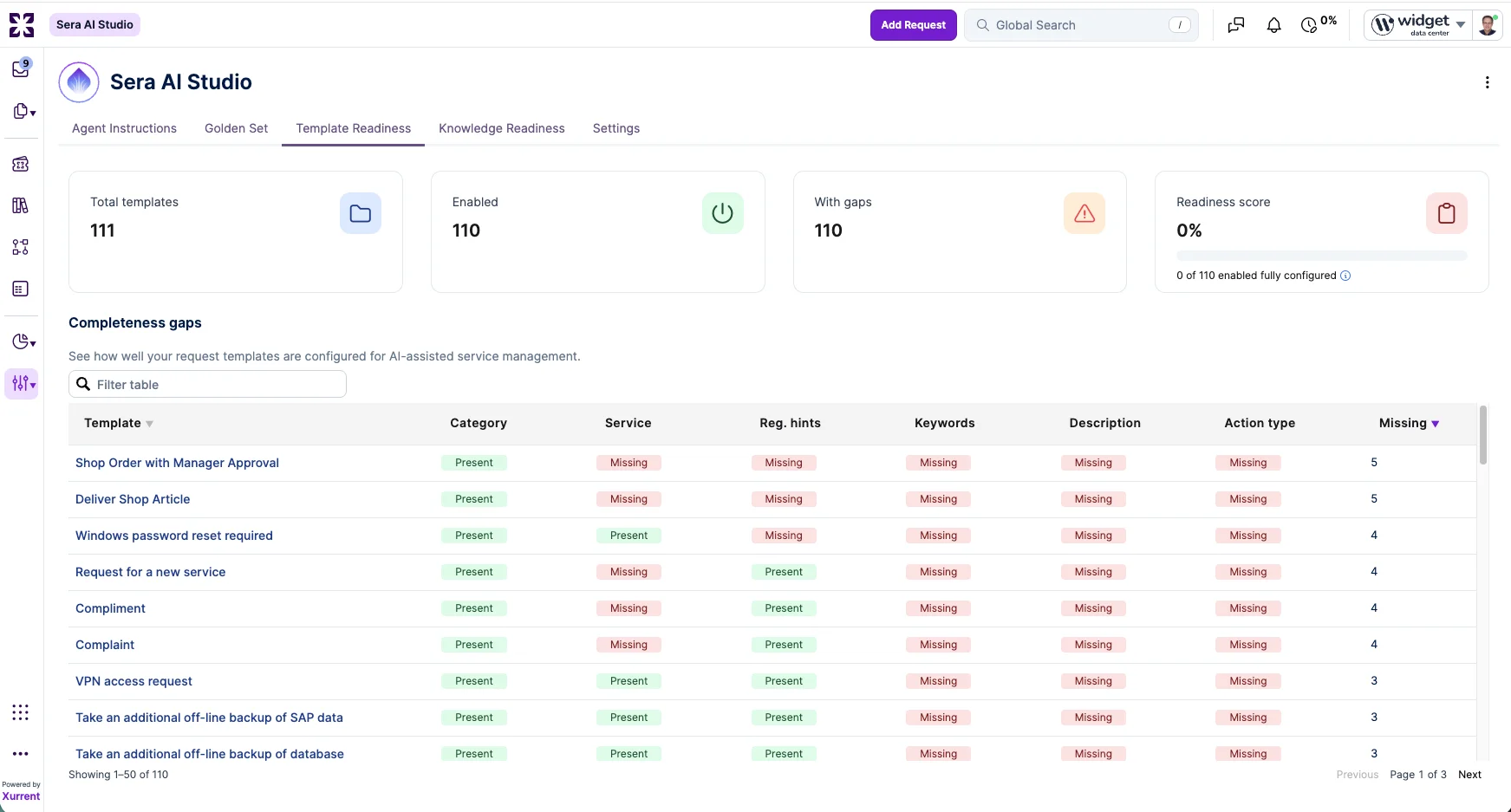
What Sera AI Studio provides:
AI deployment stays in your hands. You configure, test, and deploy on your own timeline, without submitting feedback and waiting for a vendor roadmap. Xurrent provides the platform and the guardrails. You control the pace.
Every feature described above works within the Xurrent platform. The Xurrent MCP Server extends that intelligence outward.
MCP (Model Context Protocol) is an open standard that lets external AI tools and agents communicate with software platforms. Xurrent's MCP Server lets your team interact with Xurrent's operational data and act on it using whatever AI client they already use, whether that's Claude, ChatGPT, a custom LLM, or an AI agent working on your behalf.
Xurrent provides two MCP servers:
For organizations already operating in an AI-forward environment, MCP makes Xurrent part of your connected AI ecosystem. Your preferred LLMs can read and act on Xurrent data. Your AI agents can interface with your service platform natively. Every action taken through MCP carries the same permissions, audit trail, and security model as actions taken through the UI, because it runs on the same governed platform.
MCP connects Xurrent to the broader world of AI, on an open standard, included in every subscription.
Xurrent's agent skills move AI past answering questions and into doing the work itself.
Xurrent's agent skills are purpose-built AI capabilities that let AI agents take on defined roles within your workflows. Administrators assign each agent a role, similar to how a human specialist receives access and privileges within Xurrent, and a set of skills that define what it can do.
Examples of agent skills:
Every agent skill operates with full auditability. You define the role, assign the skills, and see every action the agent takes, with nothing hidden in a black box.
Xurrent treats agent skills as a governed capability, not industry hype. Organizations offload real work to AI at their own pace, with every action traceable and reversible.
The Xurent Virtual Agent, available on Self-Service, interacts with end users to aid them as they seek assistance. The goal: bias the Virtual Agent towards action. An example — as discussed in this product update — is a user entering “I need a new Oracle database by the end of the year” into the chatbot. The Virtual Agent immediately opens a ticket and routes it using the “AI auto-classifier.”
The Virtual Agent can:
Want more details? Read our product update.
Generative AI is ideally suited to read and summarize large bodies of content. All requests in Xurrent are automatically summarized once they reach predefined thresholds. On average, over 2,000 summaries are created per customer per week. This translates to significant productivity gains, which leads to fewer resources being required to support growth demands.
(summary in purple section below)
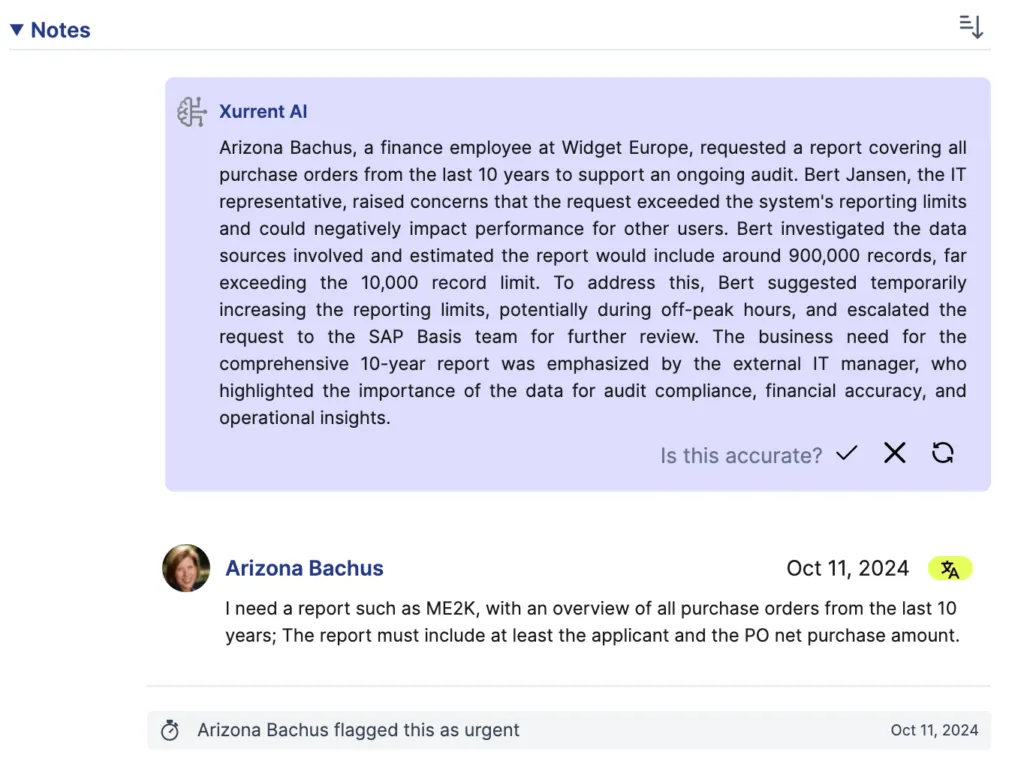
Provide instant feedback on AI request summaries by answering the question “Is this accurate?” with either ✓ or x, opening a new dialog window to supply specifics. This allows the Xurrent AI team to troubleshoot the summary feature and ultimately improve it.
(summary feedback can be seen in purple section of screenshot above)
If a request is “stuck” in “Waiting for Customer” status for a certain period – with no response from the requester, a follow-up message is sent. The system can trigger the AI to add a short summary of the request and specify what action or information is required from the requester so that the specialist can continue.
The solution to a request or problem is often not written in a single knowledge article or note. Xurrent’s generative AI assists in creating new knowledge articles (KAs) or updating (improving) existing articles to improve their effectiveness … based on all the notes from that record. It can suggest a subject, description, and instructions for the desired knowledge article … automatically.
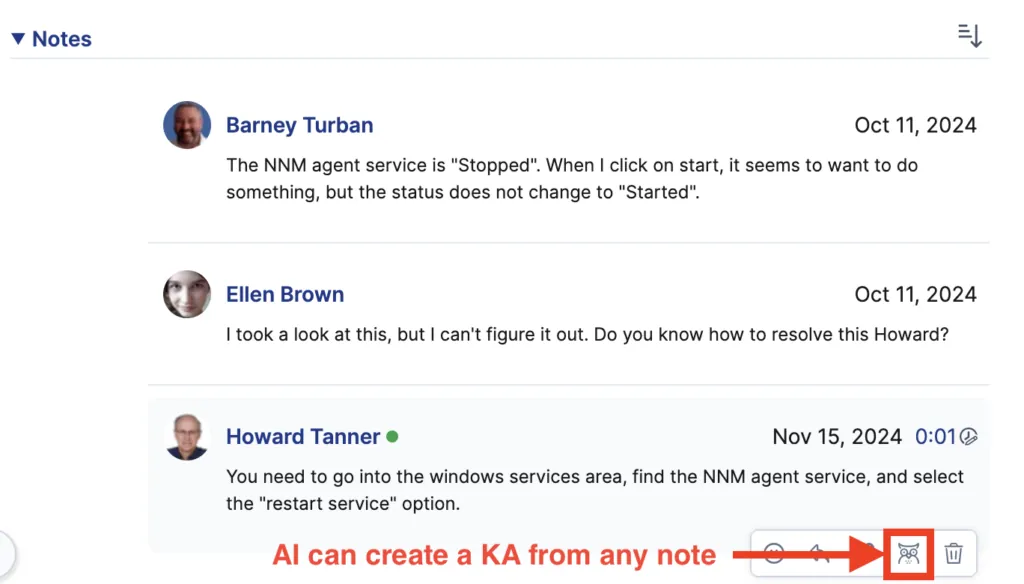
The AI also provides all relevant details after adding a basic level of information to a KA, saving valuable time and ensuring the content within the KA is as accurate as possible.
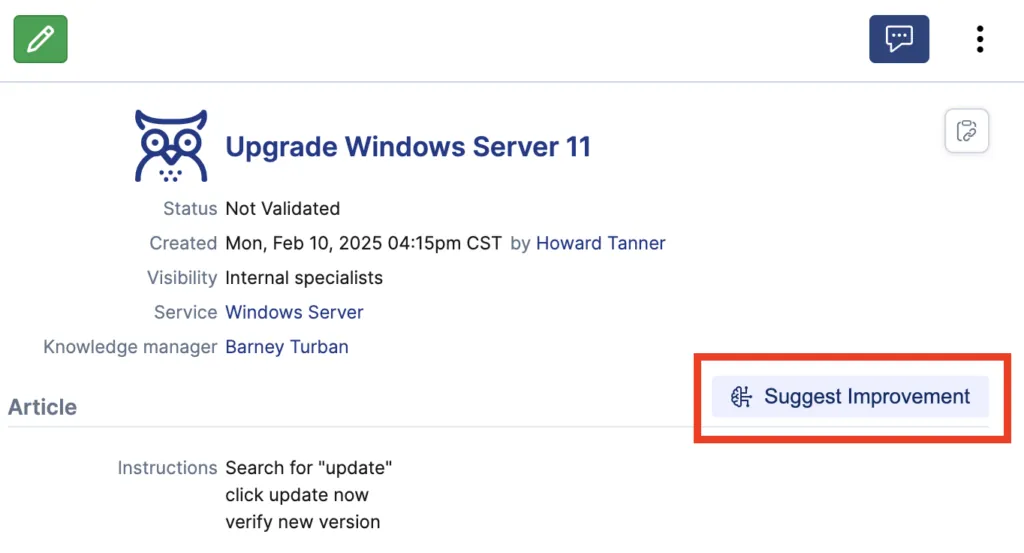
With Sera AI, anyone can create detailed and accurate KAs. But remember, before saving, please check for accuracy, completeness, and appropriateness.

One of the significant challenges in all ITSM solutions is correctly categorizing requests. In many organizations, 20% or more of requests are uncategorized, leading to longer ticket response and resolution times. Sera AI automatically categorizes all requests and provides the reasoning which led to the chosen category so that it can be tuned to become more accurate over time.
Sera AI will automatically build a new automation based on a prompt. Simply describe in words how the automation should work, and Xurrent will automatically build it. This can save 5-30 minutes per automation. That adds up to massive productivity gains over the lifespan of Xurrent usage.


This feature allows every user or end customer to work using their preferred language. Our AI-driven, multi-language translation engine works behind the scenes, instantaneously translating requests, comments, and more into the preferred language of each team member or requestor – enabling seamless communication and cooperation across all regions.
Currently, Xurrent Auto-Translation supports over 57 languages.

Google Docs has “Help me write.”
Apple Intelligence has “Rewrite.”
Xurrent now has “Note Assist.”
These creative writing aids, as they are called, help writers write better.
Let’s take the sentence above, which is quite vanilla and unengaging and run it through a creative writing aid to spice it up a bit.
The new definition of creative writing aids = These AI writing tools take hastily written support tickets — with their typos, unclear explanations, and technical jargon — and reshape them into polished, reader-friendly messages that actually solve problems.
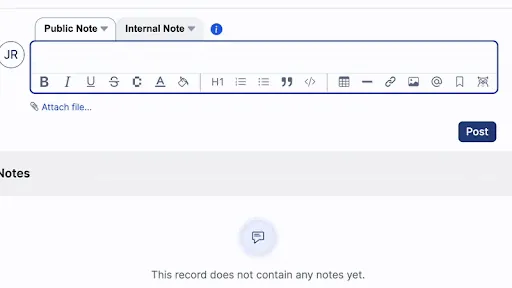
Now, when using Xurrent, you will most likely not need to turn your words into Hemingway prose; however, it will definitely clean up your words and phrases to ensure they are grammatically correct and easier to understand.
Here is an animated GIF showcasing Xurrent’s new AI Note Assist in action.
Below is a short recap of all of the AI-enabled features and functionality of Xurrent IMR, specifically:
Xurrent IMR instantly distills incident data — logs, alerts, chat threads — into crisp summaries that highlight impact and status. Teams get clarity in seconds without sifting through noise.
Need granular info mid-incident? Just ask. The AI Querier supports natural-language queries, such as "What triggered the latency spike?" —delivering insights drawn from incident context.
Post-incident writeups are tedious — and now automated. Xurrent IMR's AI Postmortem pulls from data across systems to generate complete, customizable reports in minutes.
On-call scheduling becomes easier with Sera AI: optimized rotations, coverage balancing, and painless shift swaps — no calendars or spreadsheets required.
Read Zenduty by Xurrent AI Roundup: Zenduty's AI-Driven Incident Management post for more details.
Sera AI is available across the Xurrent platform, designed to be adopted in minutes, not months, with outcomes that compound over time.
This isn’t AI as a feature. It’s AI as critical infrastructure, a fabric that supports, learns, and elevates your service operations every step of the way.
As a result of Xurrent’s investment in secure AI, over 90% of Xurrent’s customers have already enabled AI and are realizing incredible productivity gains as a result.
Get started with Xurrent’s Sera AI today and lead your organization into a more productive tomorrow.

.webp)
Most enterprise AI is a chatbot stuck to the side of your tools. We built something different. Two MCP servers, one for incident response and one for service operations, that let you ask your operational data anything, and in the case of ITSM, act on it, using whatever AI client your team already uses.
Most AI SREs are pattern matchers trained on public data. They know what a memory leak looks like in the abstract. They don't know that your payments-api has a flaky liveness probe everyone ignores, that the checkout team owns the retry policy, or that the last three "database incidents" were actually cache misconfigurations. That knowledge lives in your postmortems, your Slack channels, and the heads of two senior engineers.
Most vendors will tell you ITSM implementation takes six months to a year — but modern, configuration-first platforms have rewritten the math entirely. See what real implementations look like in 2026, and why a long rollout is now a choice, not a given.
.webp)
.webp)
.webp)