





Blog
Insights & updates from our experts


Resolve plant floor and IT issues before they disrupt production.

Stay audit-ready while resolving issues and reducing operational risk.
Resolve issues quickly with an AI-powered system that automates ticketing.
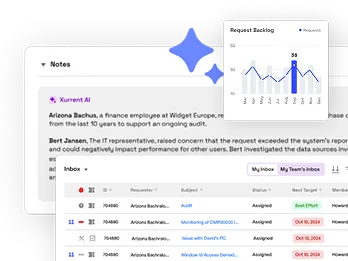
Unifiy IT, HR, Facilities, Finance, and more on a single, AI-powered service platform.
Simplify on-call scheduling, automate escalations, and reduce burnout.
Automate postmortems, AI summaries, and post-incident workflows
Create, organize, and continuously improve your knowledge base to find the right answers with Sera AI.

We're here to help

The integration with Atlassian Jira using the Xurrent Integration Service is

The integration with Atlassian Jira using the Xurrent Integration Service is

The integration with Atlassian Jira using the Xurrent Integration Service is

The integration with Atlassian Jira using the Xurrent Integration Service is

The integration with Atlassian Jira using the Xurrent Integration Service is

The integration with Atlassian Jira using the Xurrent Integration Service is

The integration with Atlassian Jira using the Xurrent Integration Service is

The integration with Atlassian Jira using the Xurrent Integration Service is
Resolve issues quickly with an AI-powered system that automates ticketing.
Unifiy IT, HR, Facilities, Finance, and more on a single, AI-powered service platform.
Simplify on-call scheduling, automate escalations, and reduce burnout.
Automate postmortems, AI summaries, and post-incident workflows
Create, organize, and continuously improve your knowledge base to find the right answers with Sera AI.
Resolve plant floor and IT issues before they disrupt production.
Stay audit-ready while resolving issues and reducing operational risk.

Detect, respond, and resolve incidents fast to cut downtime and MTTR.

Keep your store online, even during your biggest sales moments.

Protect patient data and resolve issues fast, so care teams stay focused on care.

Standardize service delivery across every store and channel.

We are here to help 24/7

Connect with other Xurrent Users

Get insights and tips on how to get the most out of Xurrent

Apps, APIs, and updates

Xurrent service functionality

Eliminate manual tasks, optimize workflows, and deliver faster resolutions.
Learn how organizations have reduced downtime, improved 50% MTTA & MTTR, and cut costs with Xurrent IMR.
Discover Xurrent IMR's quick support, bidirectional integrations with Jira and Slack, and more cohesive incident response capabilities compared to Opsgenie.
Understand why users value Xurrent IMR for its intuitive interface, efficient incident alerting, customizable On-call schedules, and escalations.
In the increasingly complex digital landscape of 2026, organizations are under immense pressure to optimize operations, enhance efficiency, and deliver unparalleled service experiences. Amidst this imperative, ServiceNow frequently emerges as a front-runner, lauded for its comprehensive capabilities and robust platform. However, a persistent question echoes through boardrooms and IT departments alike: Is ServiceNow's premium pricing truly justified, or are there more strategic alternatives available? This article delves into the intricacies of ServiceNow's cost structure, scrutinizes its value proposition, and ultimately presents a compelling argument for a more streamlined, cost-effective approach to service delivery.
The decision to invest in an enterprise service management platform is not merely a technological one; it is a strategic financial commitment that can profoundly impact an organization's operational agility and fiscal health for years to come. With ServiceNow, the allure of a "platform of platforms" is undeniable, yet the journey from initial inquiry to fully operational system is often fraught with opaque pricing, unforeseen expenditures, and a complex licensing labyrinth. Is your organization adequately prepared to navigate these challenges, or are you inadvertently committing to a future of escalating costs and potential underutilization?
Comment
byu/estu4444 from discussion
inservicenow
Engaging with ServiceNow or one of its authorized partners immediately introduces organizations to the "custom quote" maze. Unlike many enterprise software solutions with transparent, tiered pricing, ServiceNow operates on a model that can feel deliberately enigmatic. Potential clients are rarely presented with straightforward price lists; instead, they are funneled into discussions that culminate in a bespoke quotation. This process, while seemingly tailored, often obscures the true cost drivers and makes direct comparisons with alternative solutions incredibly challenging. Are you receiving a fair and optimized offer, or are you merely accepting the terms presented without a clear understanding of the underlying value?
This approach inherently favors the vendor, creating an information asymmetry that can disadvantage the buyer. Organizations often find themselves in negotiations without a clear benchmark, making it difficult to ascertain if they are securing the best possible terms. The reliance on partners, while providing expertise, also introduces an additional layer of complexity and potential markups. This initial engagement sets the tone for the entire relationship, one where understanding and controlling costs becomes an ongoing, significant effort.
As per a few users who voiced this issue over at reddit when it comes to pricing that has always left users questioning what they need to pay:
How much is Servicenow? Can't find pricing publicly. Thinking about using it for a small business (less than 10 staff)
byu/ComparisonLiving6793 inservicenow
ServiceNow has meticulously cultivated an image far beyond that of a mere help desk solution. It is positioned, quite accurately, as a "platform of platforms" – a single, unified environment designed to digitize and automate a vast array of enterprise service workflows across IT, HR, customer service, and more. This broad scope is indeed a significant differentiator, offering the promise of consolidated data, streamlined processes, and a single pane of glass for enterprise service management.
The strategic vision behind this "platform of platforms" is to eliminate departmental silos, foster cross-functional collaboration, and drive organizational efficiency. When successfully implemented, ServiceNow can indeed deliver on these promises, transforming fragmented operations into a cohesive service delivery ecosystem. However, this expansive capability comes with a commensurate price tag, not just in initial licensing but in the ongoing management, customization, and integration efforts required to fully leverage its potential. The question then becomes, is your organization prepared to fully utilize and extract value from this extensive platform, or are you effectively paying for capabilities you will never fully exploit? This distinction is critical in assessing the true cost-benefit ratio.
Comment
byu/onetimeuseforreddit from discussion
insysadmin
Understanding the variables that dictate your ServiceNow license cost is paramount to effective budget planning and negotiation. It’s a multifaceted equation influenced by module selection, user types, industry specifics, and the scale of deployment. Navigating these factors requires a granular understanding to avoid budgetary surprises.
At the heart of many ServiceNow deployments are its core modules:
The selection and combination of these modules are foundational to your overall spend. Each module represents a distinct value proposition and, critically, a distinct financial commitment. Are you meticulously evaluating which modules are truly essential for your immediate and strategic objectives, or are you adopting a broad suite of capabilities that may outstrip your current operational needs? An uncritical adoption of multiple modules without a clear utilization strategy invariably leads to overspending.
ServiceNow's expansion beyond traditional IT is a testament to its "platform of platforms" strategy, with modules like HR Service Delivery (HRSD) and Security Operations (SecOps) demonstrating its versatility:
The decision to implement these additional modules represents a strategic choice to consolidate enterprise services on a single platform. While offering potential synergies and simplified reporting, each new module significantly inflates the overall cost. Is the benefit of platform consolidation truly outweighing the incremental cost of licensing and implementing these specialized functionalities on ServiceNow, particularly when best-of-breed alternatives might exist at a lower total cost of ownership?
ServiceNow also tailors its offerings and, consequently, its pricing for specific industries. Highly regulated sectors such as Healthcare, Financial Services, and Public Sector often require specialized compliance features, data security protocols, and integration capabilities that are bundled into industry-specific solutions. These verticalized offerings, while addressing critical industry requirements, often command a premium. The complexity of these environments necessitates more robust configurations, extensive testing, and often dedicated support, all of which are reflected in the final quotation.
For instance, a healthcare provider might require specific integrations with Electronic Health Record (EHR) systems and adherence to HIPAA regulations, while a financial institution demands stringent data sovereignty and compliance with regulations like GDPR or SOX. ServiceNow’s ability to cater to these intricate needs is a strong selling point, but it inherently translates into higher costs. Is your organization truly leveraging these industry-specific functionalities to their full extent, or are you paying an "industry tax" for features that are only partially utilized?
Despite the "custom quote" opacity, industry insights and user testimonials reveal consistent pricing patterns. ServiceNow fulfillers typically range from $150-$300+ per user per month, with ITSM forming the baseline and specialized modules like ITOM, CSM, and SecOps commanding premium rates. Mid-market organizations with 50 fulfillers commonly face annual license fees between $150k-$400k, depending on module selection and negotiation effectiveness.
Enterprise deployments with 500+ fulfillers and comprehensive module coverage routinely exceed $1M-$3M in annual licensing alone. When factoring in the implementation multiplier, ongoing support, and hidden add-ons, total first-year costs frequently reach $500k-$2M for mid-market and $3M-$10M+ for large enterprises. These figures exclude the substantial ongoing administrative overhead required to maintain complex ServiceNow environments.
The stark reality is that ServiceNow's "premium" positioning translates into premium costs at every level. Organizations must critically evaluate whether this investment aligns with their operational requirements and budget constraints, or if a more focused, cost-effective platform would deliver equivalent outcomes without the financial burden.
The nuanced licensing model employed by ServiceNow is a frequent source of confusion and unexpected costs. It's not simply a per-user model; instead, it differentiates users based on their interaction level with the platform. Misinterpreting these distinctions can lead to significant budgetary overruns.
At its core, ServiceNow licensing distinguishes between Fulfillers and Requesters:
The critical distinction lies in the degree of interaction and the capabilities accessed. If an end-user needs to perform actions beyond basic request submission – such as approving a change, managing a specific asset, or running detailed reports – they may inadvertently cross into a gray area that could necessitate a more expensive license type. Are you meticulously auditing user roles and permissions to ensure that individuals are not inadvertently consuming fulfiller licenses for tasks that could be accomplished with less costly access? This often overlooked area is a prime candidate for cost optimization.
Beyond the clear fulfiller/requester divide, organizations often encounter the hidden cost of the business stakeholder. These are individuals, typically in management or oversight roles, who require access to dashboards, reports, and perhaps limited approval workflows to monitor service performance or authorize changes. While they are not "fulfillers" in the traditional sense, their need for advanced reporting and interaction often necessitates a specific license type that is more expensive than a basic requester but potentially less feature-rich than a full fulfiller license.
These "stakeholder" licenses can accumulate quickly, especially in large enterprises with numerous departmental managers and project leads who need visibility into operational metrics. The temptation is to grant these individuals fulfiller licenses for convenience, further escalating costs. Have you clearly defined the exact level of access required for every business stakeholder, ensuring they are not over-licensed for their specific functional needs? This is a critical area for detailed analysis and negotiation.
The Configuration Management Database (CMDB) and Asset Management functionalities are cornerstones of effective ITSM and ITOM. However, their utilization also comes with specific licensing implications. ServiceNow often licenses these capabilities based on the number of configuration items (CIs) or assets being managed within the platform.
For organizations with extensive and complex IT infrastructures, managing tens of thousands or even hundreds of thousands of CIs can lead to substantial licensing costs. Furthermore, the granularity of data within the CMDB and the frequency of updates can influence the required licensing tiers. Are you accurately forecasting the volume and complexity of CIs and assets you intend to manage within ServiceNow, ensuring that your licensing model accounts for this growth without incurring unexpected penalties? An underestimation here can result in significant unbudgeted expenses as your CMDB matures.
The digital forums, user groups, and community discussions surrounding ServiceNow are a trove of candid opinions regarding its pricing. While the platform garners significant praise for its capabilities, a recurring theme in these discussions revolves around the financial commitment it demands.
The community consensus on ServiceNow's "value for money" is nuanced, often polarizing. Many long-term users attest to the platform's ability to drive significant operational efficiencies, consolidate disparate tools, and deliver a superior service experience. They frequently cite the platform's scalability, robust feature set, and ecosystem of integrations as justifications for its premium price. For these organizations, the investment has demonstrably translated into tangible business outcomes, making the cost worthwhile.
However, an equally vocal segment of the community expresses concerns that the perceived value does not always align with the actual expenditure. These users often highlight scenarios where:
Does your organization possess the internal capabilities and strategic vision to fully leverage ServiceNow's extensive feature set, or are you at risk of becoming another statistic in the "underutilized platform, overpriced solution" narrative? This self-assessment is crucial.
Beyond the broader value debate, specific frustrations regarding ServiceNow pricing frequently emerge:
These community insights underscore a critical reality: while ServiceNow offers robust capabilities, managing its costs effectively requires constant vigilance, meticulous planning, and a deep understanding of its intricate pricing model.
ServiceNow’s sticker price, as daunting as it can be, often represents only a fraction of the total cost of ownership. Organizations frequently discover a cascade of hidden costs that emerge during implementation and ongoing operation, significantly inflating the overall investment.
One of the most significant hidden costs is the implementation itself. Deploying a ServiceNow instance is rarely a plug-and-play operation, particularly for enterprises leveraging its "platform of platforms" capabilities. The complexity involved in configuring modules, integrating with existing systems, migrating data, and customizing workflows often necessitates extensive professional services.
Industry experts and user testimonials consistently suggest that implementation costs can be anywhere from 3 to 5 times the annual software license fee. This multiplier accounts for:
Has your organization accurately factored in this substantial implementation multiplier into your budget, or are you approaching ServiceNow deployment with an underestimation of the professional services required? A failure to account for this can lead to project delays, scope creep, and severe budgetary overruns.
ServiceNow's "App Engine" is a powerful capability that allows organizations to build custom applications and automate unique workflows directly on the platform. This low-code/no-code environment promises agility and innovation, enabling businesses to extend the platform's functionality to address specific operational needs.
However, the App Engine can also become a significant hidden cost trap:
The allure of building bespoke solutions is strong, but organizations must carefully weigh the benefits against the long-term costs of development, maintenance, and potential future migration hurdles. Are you judiciously assessing whether a custom App Engine solution is truly necessary, or if a standard, out-of-the-box feature (or a more cost-effective alternative) could suffice?
Beyond the core modules, ServiceNow offers a suite of "essential" add-ons that enhance functionality but come with additional price tags:
These add-ons, while powerful, move organizations further away from the base platform cost. They are often presented as crucial for maximizing the platform's value, which, while true, implies that the "base" offering may not be fully sufficient for modern enterprise needs. Are you meticulously evaluating the necessity of each add-on, distinguishing between "must-have" enhancements and "nice-to-have" features that significantly increase your overall spend?
The complexities and escalating costs associated with ServiceNow compel organizations to seek alternatives that deliver comparable value without the prohibitive financial burden and labyrinthine licensing. Enter Xurrent, a robust and strategically designed platform engineered to provide a unified, efficient, and significantly more cost-effective approach to enterprise service delivery. Xurrent directly addresses the pain points of the ServiceNow ecosystem, offering a transparent, high-value solution.
The table below provides a side-by-side analysis of the estimated 3-year Total Cost of Ownership (TCO) for a Mid-Sized Organization (50 Fulfillers) versus a Large Enterprise (500 Fulfillers + ESM).
| Cost Driver | ServiceNow | Xurrent | Impact |
|---|---|---|---|
| Implementation | High (3x-5x) Requires certified partners. | Low ( Rapid, out-of-box setup. | ~80% Savings |
| Admin | Heavy Dedicated FTEs required. | Light Low-code, no dedicated FTE. | High Savings |
| Modules | Pay-Per-Module HR/CSM cost extra. | Unified All features included. | Zero Tax |
| Upgrades | Costly Breaks customizations. | Seamless Automatic updates. | Zero Debt |
| Scenario | ServiceNow | Xurrent | Savings |
|---|---|---|---|
| Mid-Sized 50 Fulfillers | ~$800k+ | ~$250k | ~68% Less |
| Enterprise 500 Fulfillers | ~$6M+ | ~$1.5M | ~75% Less |
Note: Estimates include licensing, implementation services, and required personnel salaries based on 2026 market averages.
Xurrent redefines enterprise service management with its Unified ServiceOps paradigm. Unlike fragmented solutions or platforms that require costly add-ons to achieve full functionality, Xurrent natively integrates core service management disciplines into a single, cohesive environment. This eliminates the need for separate modules and complex integrations that drive up ServiceNow's TCO.
Xurrent's Unified ServiceOps platform inherently combines:
When these drivers are applied to real-world scenarios, the cost disparity becomes clear. Xurrent typically delivers the same operational outcomes for one-third of the total cost.
By prioritizing an exceptional self-service experience from the ground up, Xurrent significantly reduces the burden on fulfillers, minimizes "shadow IT," and empowers end-users. Why invest heavily in customizing a complex platform when a purpose-built alternative delivers a superior end-user experience with less effort and at a fraction of the cost? Xurrent ensures that your investment directly translates into enhanced user satisfaction and operational efficiency, without the hidden development costs often associated with competing platforms.
The imperative to optimize IT budgets for 2026 is undeniable. Organizations are seeking maximum value from every dollar spent, demanding solutions that are not only technologically advanced but also fiscally responsible. The strategic decision between a premium platform like ServiceNow and a robust, cost-effective alternative like Xurrent will significantly shape your financial outlook.
The "platform of platforms" narrative, while compelling, often leads organizations to acquire an extensive suite of functionalities they may never fully utilize. ServiceNow, with its vast array of modules and add-ons, can be overkill for many businesses. This creates a significant disparity between licensed capabilities and actual operational use, resulting in substantial wasted expenditure.
Consider this critical self-assessment:
Are you genuinely leveraging 80% or more of the features within your current or proposed ServiceNow deployment, or are you paying a premium for capabilities that remain dormant? The cost-benefit analysis often reveals that a significant portion of the platform's advanced functionalities goes unutilized, making the high price tag difficult to justify.
Xurrent offers a strategic counter-argument: deliver 90% of the critical enterprise service management functionality at a fraction of the cost, without the overhead of unused features or the complexity of managing an overly broad platform. This focused approach ensures that your investment directly supports your core operational needs without extraneous expenses.
For organizations currently entrenched in the ServiceNow ecosystem, the notion of migration might seem daunting. However, the long-term financial benefits and operational efficiencies of migrating to a more streamlined and cost-effective platform like Xurrent are often too significant to ignore.
Migrating to Xurrent is not merely a lateral move; it is an opportunity to modernize your service delivery landscape, shedding the accumulated technical debt and budgetary bloat associated with legacy enterprise platforms. This modernization involves:
In conclusion, while ServiceNow undoubtedly offers a powerful, expansive platform, its premium pricing, opaque licensing, and hidden implementation costs demand rigorous scrutiny in 2026. Organizations must critically evaluate whether the perceived value justifies the substantial financial commitment. Xurrent emerges as a compelling, modern alternative, offering a unified, cost-effective, and user-centric approach to enterprise service delivery. The choice is clear: continue navigating the "custom quote" maze with its inherent risks and escalating costs, or strategically migrate and modernize with Xurrent to achieve unparalleled efficiency and significant budgetary savings. The time for a more intelligent service management investment is now.
ServiceNow's TCO is driven by the "Implementation Multiplier." Beyond the license fee, organizations typically spend 3x–5x more on certified implementation partners, dedicated full-time administrators, and separate modules for features like HR or CSM. Xurrent eliminates this by offering a unified platform that requires minimal configuration and no dedicated admin headcount.
No. Unlike competitors that charge separately for ITSM, ESM, and CSM modules, Xurrent provides a Unified ServiceOps platform. You get comprehensive Enterprise Service Management capabilities out of the box, allowing you to extend service delivery to HR, Facilities, and Legal without incurring an "Expansion Tax."
We believe in transparency. While legacy vendors often use opaque, custom quoting to maximize deal size, Xurrent offers straightforward, predictable pricing. You won't need to hire a consultant just to decipher your invoice or negotiate a fair renewal.
The biggest hidden cost is Technical Debt. Because ServiceNow relies on heavy customization, every platform upgrade can break your unique workflows, requiring expensive regression testing and developer hours to fix. Xurrent’s single-codebase architecture ensures upgrades happen automatically without breaking your setup.
Absolutely. Xurrent is architected for the enterprise, supporting complex global deployments, MSPs, and large-scale service networks. Our "Service Integration and Management" (SIAM) capabilities allow large organizations to seamlessly collaborate with external vendors and partners within a single secure environment.
Xurrent includes AI-driven capabilities to assist agents, route tickets, and suggest knowledge articles. Unlike legacy platforms that package AI as a premium "Pro" or "Enterprise" add-on, we believe intelligent automation is core to modern service management, not a luxury tax.
While legacy implementations take 6–12 months, Xurrent customers typically go live in weeks. Our standardized, best-practice workflows allow you to focus on adoption rather than configuration, drastically accelerating your Time-to-Value.
You can start with a "Surround and Expand" strategy. Use Xurrent for specific high-velocity teams, external vendor collaboration, or ESM use cases (like HR) where ServiceNow is too costly or rigid. Xurrent integrates seamlessly, allowing you to offload cost while keeping your core system of record until you are ready to switch fully.