




Blog
Insights & updates from our experts


Resolve plant floor and IT issues before they disrupt production.

Stay audit-ready while resolving issues and reducing operational risk.
Resolve issues quickly with an AI-powered system that automates ticketing.
Unifiy IT, HR, Facilities, Finance, and more on a single, AI-powered service platform.
Simplify on-call scheduling, automate escalations, and reduce burnout.
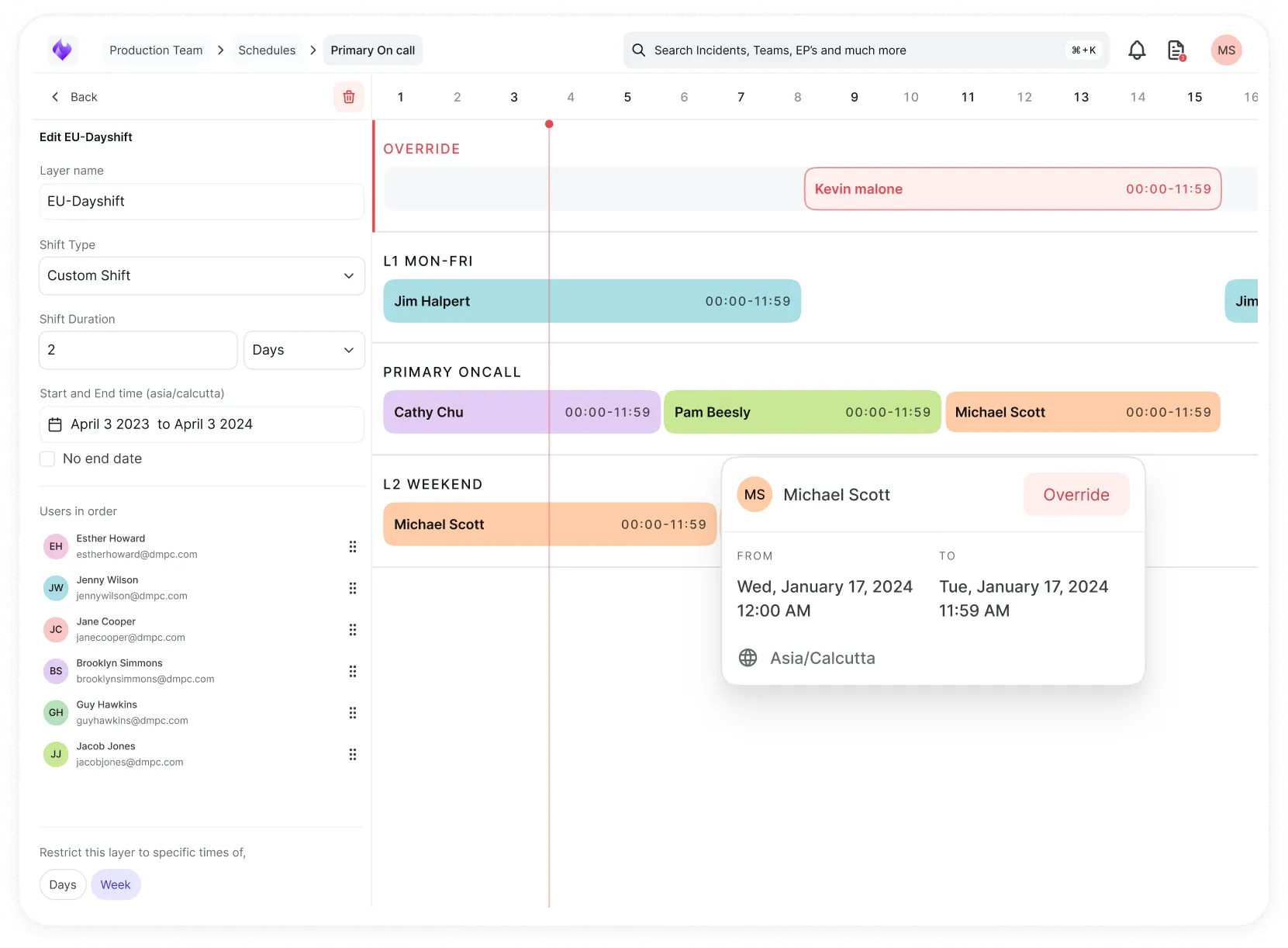
Automate postmortems, AI summaries, and post-incident workflows
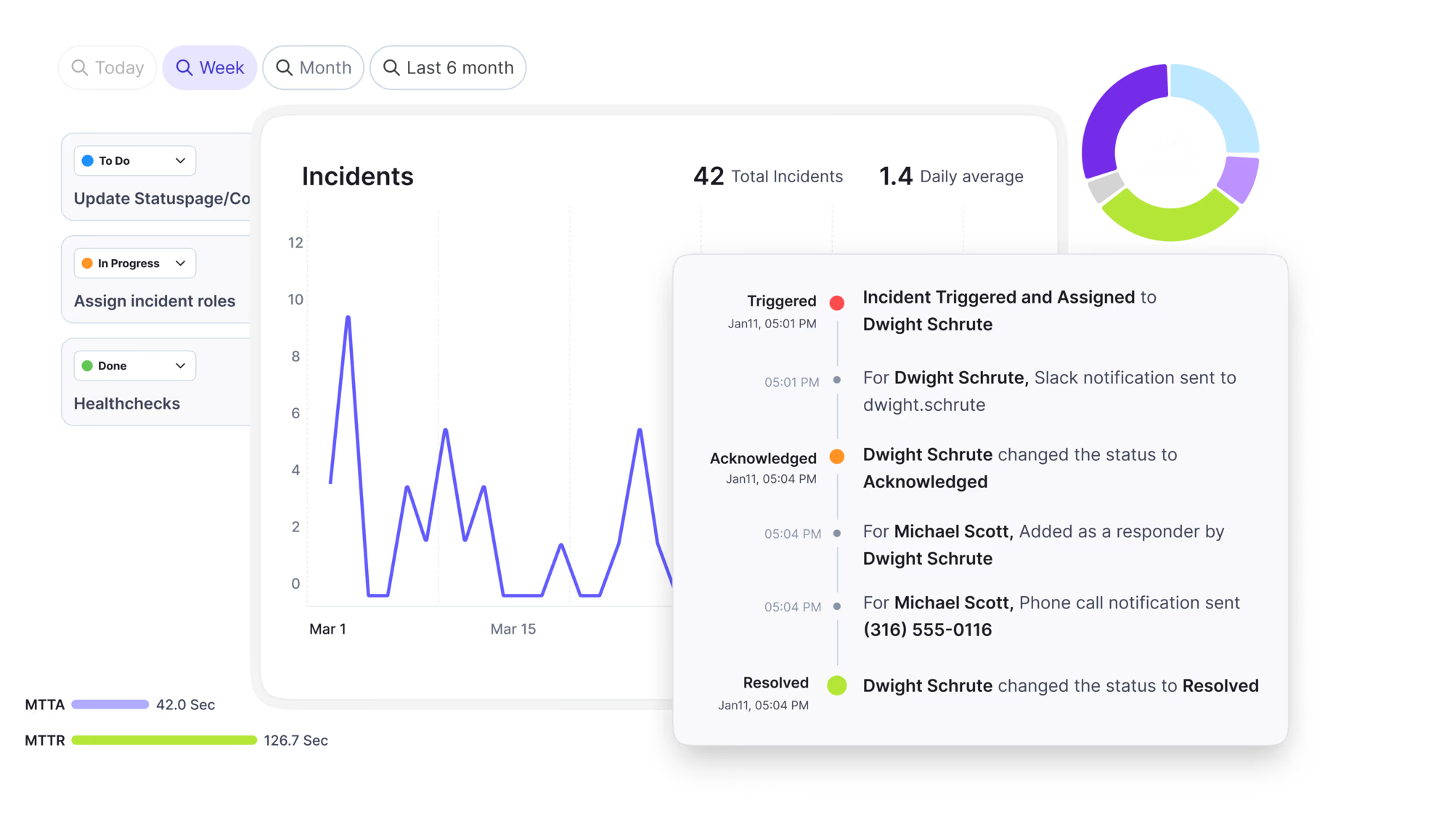
Create, organize, and continuously improve your knowledge base to find the right answers with Sera AI.
We're here to help

The integration with Atlassian Jira using the Xurrent Integration Service is

The integration with Atlassian Jira using the Xurrent Integration Service is

The integration with Atlassian Jira using the Xurrent Integration Service is

The integration with Atlassian Jira using the Xurrent Integration Service is

The integration with Atlassian Jira using the Xurrent Integration Service is

The integration with Atlassian Jira using the Xurrent Integration Service is

The integration with Atlassian Jira using the Xurrent Integration Service is

The integration with Atlassian Jira using the Xurrent Integration Service is
Resolve issues quickly with an AI-powered system that automates ticketing.
Unifiy IT, HR, Facilities, Finance, and more on a single, AI-powered service platform.
Simplify on-call scheduling, automate escalations, and reduce burnout.
Automate postmortems, AI summaries, and post-incident workflows
Create, organize, and continuously improve your knowledge base to find the right answers with Sera AI.
Resolve plant floor and IT issues before they disrupt production.
Stay audit-ready while resolving issues and reducing operational risk.

Detect, respond, and resolve incidents fast to cut downtime and MTTR.

Keep your store online, even during your biggest sales moments.

Protect patient data and resolve issues fast, so care teams stay focused on care.

Standardize service delivery across every store and channel.

We are here to help 24/7

Connect with other Xurrent Users

Get insights and tips on how to get the most out of Xurrent

Apps, APIs, and updates

Xurrent service functionality

Eliminate manual tasks, optimize workflows, and deliver faster resolutions.
Learn how organizations have reduced downtime, improved 50% MTTA & MTTR, and cut costs with Xurrent IMR.
Discover Xurrent IMR's quick support, bidirectional integrations with Jira and Slack, and more cohesive incident response capabilities compared to Opsgenie.
Understand why users value Xurrent IMR for its intuitive interface, efficient incident alerting, customizable On-call schedules, and escalations.
HaloITSM pricing follows a per-agent monthly subscription model, typically landing between $50 and $70 per agent per month with all ITIL modules, integrations, and asset management included—no hidden fees for individual features. Both cloud and on-premise deployments use the same pricing structure, though total cost of ownership varies depending on your infrastructure choices.
This guide breaks down HaloITSM's pricing tiers, compares cloud versus on-premise costs, and stacks the platform against alternatives like ServiceNow, Freshservice, and Xurrent so you can evaluate whether it fits your budget and operational requirements.
HaloITSM is an ITIL-aligned IT service management platform built for teams handling incident tickets, change requests, and service desk workflows. If you've worked with tools like ServiceNow or Freshservice, you'll find familiar territory here—though HaloITSM positions itself as a simpler, more accessible option for mid-market organizations.
The platform covers the core ITIL practices: incident management, problem management, change enablement, and request fulfillment. It also includes asset tracking and a configuration management database (CMDB), which maps relationships between your hardware, software, and services. For teams outgrowing spreadsheets or basic ticketing tools, HaloITSM offers a structured path forward without the complexity of enterprise-grade suites.
HaloITSM uses a per-agent monthly subscription model, with pricing typically landing between $50 and $70 per agent per month. What makes this approach different from some competitors is the all-inclusive licensing—you're not paying extra for individual ITIL modules, integrations, or asset management features. Everything comes bundled into that base subscription.
You can deploy HaloITSM either in the cloud or on your own servers. Both options follow the same per-agent pricing structure, though the total cost of ownership varies depending on which path you choose. Let's break down each option.
Cloud-hosted HaloITSM typically runs in the $49–$70 per agent per month range. The exact number depends on your team size and contract terms, so you'll want to contact their sales team for a formal quote.
With cloud deployment, HaloITSM handles the infrastructure—servers, updates, security patches, and backups. You're essentially renting access to a fully managed environment. For teams without dedicated IT infrastructure staff, this removes a significant operational burden.
The trade-off? Your data lives on HaloITSM's servers. For most organizations, that's perfectly fine. For those in finance, healthcare, or government with strict data residency requirements or regulatory constraints, it might be a dealbreaker.
On-premise deployment follows the same per-agent pricing model, but you're hosting the software on your own infrastructure. This means your team manages the servers, handles updates, and maintains the environment.
Why would anyone choose this route? Control. Some organizations operate in regulated industries where data location matters—healthcare, finance, government. Others simply prefer keeping sensitive service desk data within their own walls.
The catch is that on-premise deployments take longer to implement and require ongoing internal resources. You're trading convenience for control, and that trade-off isn't right for everyone.
For organizations with large service desk operations, HaloITSM offers what they call the "$1M Forever" enterprise package. This is a capped annual fee for unlimited users, designed to provide cost predictability at scale.
Volume discounts also kick in as your team grows. Smaller teams (under 25 agents) typically pay toward the higher end of the per-agent range, while organizations with 100+ agents see reduced rates. If you're running a service desk with 250 or more agents, enterprise-tier negotiations become available.
The short answer: expect to pay somewhere between $50 and $70 per agent per month for standard licensing. That covers either named licenses (where each agent has dedicated access) or concurrent licenses (where a pool of licenses is shared among shift-based teams).
Here's where it gets interesting. The per-agent cost isn't flat across all team sizes. Smaller teams often pay closer to $90–$95 per agent, while larger organizations negotiate lower rates through volume pricing. The 15% discount for charities, non-profits, and educational institutions also shifts the math considerably.
One thing worth noting: HaloITSM doesn't publish exact pricing on their website. You'll find ranges on third-party review sites, but getting a precise quote requires reaching out to their sales team directly.
The per-agent subscription cost looks similar on paper, but total cost of ownership tells a different story. Cloud pricing bundles everything—hosting, maintenance, updates, security—into that monthly fee. On-premise pricing covers the software license, but infrastructure costs sit on your side of the ledger.
Think of it this way: cloud deployment is like renting an apartment where the landlord handles repairs. On-premise is like buying a house where you're responsible for the roof, the plumbing, and everything else.
Cloud typically wins on time-to-value. You can be up and running faster because there's no infrastructure to provision. On-premise wins on control, particularly for organizations where regulatory requirements dictate data handling practices.
With the ITSM software market valued at $4.53 billion in 2026 and growing, comparing top ITSM tools helps ensure you're picking the right platform for your specific situation. Here's how HaloITSM stacks up against common alternatives.
Why Unified ITSM and IMR Platforms Deliver Better Value: Pricing tells only part of the story. Fragmented toolchains—where service management and incident response live in separate systems—create hidden costs that don't show up on any invoice.
Here's something that catches people off guard: asset management comes included in the standard per-agent license. There's no separate module fee for tracking hardware, software licenses, or maintaining your CMDB.
This matters because some competing platforms charge extra for asset management capabilities. If inventory visibility is a core requirement for your team—and asset management is the ITSM segment with the fastest growth at 17.9% CAGR—the bundled approach can represent real savings compared to platforms that nickel-and-dime you for each feature.
In a thread discussing whether Halo's required setup was worth it, one user shared a severe warning about renewal tactics:
The included capabilities cover hardware and software tracking, license management, and relationship mapping between configuration items. You can see which servers support which services, track warranty expirations, and maintain a clear picture of your IT environment—all without additional licensing costs.
Every pricing model has trade-offs. Understanding both sides helps you figure out whether HaloITSM fits your budget and operational reality.
Standard licensing includes access to HaloITSM's support channels—typically email and community resources. Phone support and premium support tiers may carry additional costs depending on your service level requirements.
An IT manager on r/sysadmin looking into ITSM implementation costs noted their shock at the reality of setting up Halo:
Implementation and onboarding assistance often involves separate fees, particularly for organizations that want hands-on configuration help or formal training programs. When building your budget, factor in these potential costs beyond the base subscription.
The support experience varies based on your contract terms. Some organizations find the included support sufficient for day-to-day operations, while others with complex environments or tight SLAs opt for premium tiers.
Sysadmins frequently warn peers that Halo requires heavy, developer-level coding knowledge to get real value out of it. An ITSM admin on r/sysadmin who spent 5 months building out their Halo instance gave this incredibly detailed warning:
The biggest thing you really need to know is that you need to just forget any idea of "out of the box". It is a powerful erector set. If you have a dedicated admin (which I highly suggest), that person will need to be very comfortable with SQL, JSON/utilizing APIs, and having some knowledge of HTML/CSS would be a bonus as well.
Users on review platforms like G2 and TrustRadius generally highlight value-for-money as a strength. The all-inclusive approach—where modules and integrations don't require separate purchases—resonates with teams who've been burned by add-on pricing from other vendors.
The most common complaint? Having to contact sales for quotes rather than seeing pricing upfront. Some reviewers also note that while the per-agent model is easy to understand, costs can climb quickly as teams scale. Organizations with large service desks sometimes find themselves comparing HaloITSM against platforms with different pricing structures—tiered plans, usage-based models, or flat-rate options.
While the software itself bundles features well, users consistently warn that you must budget heavily for third-party implementation consultants because of the platform's raw complexity. In a discussion on r/msp about getting Halo set up, one user warned:
With the ITSM software market valued at $4.53 billion in 2026 and growing, comparing top ITSM tools helps ensure you're picking the right platform for your specific situation. Here's how HaloITSM stacks up against common alternatives.
ServiceNow pricing sits at the enterprise end of the spectrum, significantly higher than HaloITSM. Implementation typically requires partner involvement, and total cost of ownership can be substantial. It's built for large organizations with complex service management needs and dedicated ITSM teams.
Freshservice offers tiered pricing with a free tier available for small teams just getting started. Pricing generally falls in a similar range to HaloITSM, though feature availability varies by tier. The modern interface and straightforward setup make it a solid mid-market option.
Xurrent takes a different approach by unifying ITSM and incident management on a single AI-native platform.
Rather than running separate tools for your service desk and incident response workflows, you get connected visibility from request to resolution. The configuration-over-customization philosophy means deployments typically complete in weeks rather than months, with transparent pricing and no hidden fees.
ManageEngine offers both subscription and perpetual licensing options, which appeals to organizations that prefer one-time purchases over ongoing subscriptions. Pricing tends toward the budget-friendly end of the spectrum, though teams with growing complexity should compare ManageEngine Service Desk alternatives before committing.
Pricing tells only part of the story. Fragmented toolchains—where service management and incident response live in separate systems—create hidden costs that don't show up on any invoice.
When IT and engineering teams operate in different platforms, work slows down. Context gets lost in handoffs. Teams spend time copying information between systems instead of resolving issues. A unified approach connects service requests, infrastructure alerts, and incident workflows through a shared operational fabric.
Organizations evaluating ITSM pricing often benefit from considering whether their current or planned toolchain creates unnecessary friction. Platforms that combine service management with incident response capabilities can deliver better long-term value, even when the per-agent cost looks similar on paper.
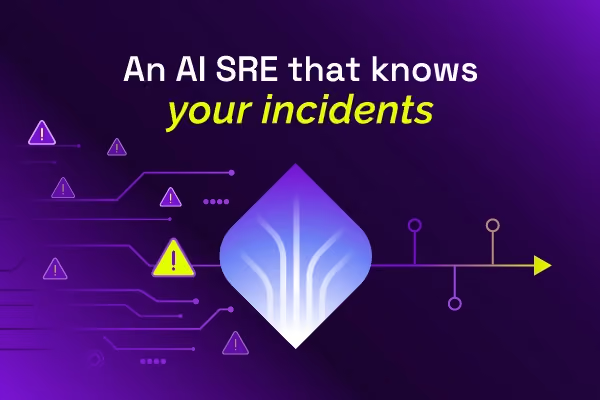
Most AI SREs are pattern matchers trained on public data. They know what a memory leak looks like in the abstract. They don't know that your payments-api has a flaky liveness probe everyone ignores, that the checkout team owns the retry policy, or that the last three "database incidents" were actually cache misconfigurations. That knowledge lives in your postmortems, your Slack channels, and the heads of two senior engineers.



.avif)