




Blog
Insights & updates from our experts


Resolve plant floor and IT issues before they disrupt production.

Stay audit-ready while resolving issues and reducing operational risk.
Resolve issues quickly with an AI-powered system that automates ticketing.
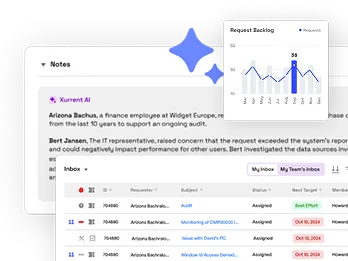
Unifiy IT, HR, Facilities, Finance, and more on a single, AI-powered service platform.
Simplify on-call scheduling, automate escalations, and reduce burnout.
Automate postmortems, AI summaries, and post-incident workflows
Create, organize, and continuously improve your knowledge base to find the right answers with Sera AI.
We're here to help

The integration with Atlassian Jira using the Xurrent Integration Service is

The integration with Atlassian Jira using the Xurrent Integration Service is

The integration with Atlassian Jira using the Xurrent Integration Service is

The integration with Atlassian Jira using the Xurrent Integration Service is

The integration with Atlassian Jira using the Xurrent Integration Service is

The integration with Atlassian Jira using the Xurrent Integration Service is

The integration with Atlassian Jira using the Xurrent Integration Service is

The integration with Atlassian Jira using the Xurrent Integration Service is
Resolve issues quickly with an AI-powered system that automates ticketing.
Unifiy IT, HR, Facilities, Finance, and more on a single, AI-powered service platform.
Simplify on-call scheduling, automate escalations, and reduce burnout.
Automate postmortems, AI summaries, and post-incident workflows
Create, organize, and continuously improve your knowledge base to find the right answers with Sera AI.
Resolve plant floor and IT issues before they disrupt production.
Stay audit-ready while resolving issues and reducing operational risk.

Detect, respond, and resolve incidents fast to cut downtime and MTTR.

Keep your store online, even during your biggest sales moments.

Protect patient data and resolve issues fast, so care teams stay focused on care.
Standardize service delivery across every store and channel.

We are here to help 24/7

Connect with other Xurrent Users

Get insights and tips on how to get the most out of Xurrent

Apps, APIs, and updates

Xurrent service functionality

Eliminate manual tasks, optimize workflows, and deliver faster resolutions.
Learn how organizations have reduced downtime, improved 50% MTTA & MTTR, and cut costs with Xurrent IMR.
Discover Xurrent IMR's quick support, bidirectional integrations with Jira and Slack, and more cohesive incident response capabilities compared to Opsgenie.
Understand why users value Xurrent IMR for its intuitive interface, efficient incident alerting, customizable On-call schedules, and escalations.

Cross-platform workflows connecting ITSM, IMR, and Status Pages.
ITxM is Xurrent's unified approach to service and incident management. It connects three product lines into a single operational environment: Xurrent ITSM for structured service delivery, Xurrent IMR for real-time incident response, and Xurrent Status Pages for stakeholder communication. Data, workflows, and AI capabilities are shared across all three.
The core principle is that service management, incident response, and status communication should not operate in separate systems. When they share the same data layer, teams stop losing context at handoff points. An alert from a monitoring tool can trigger an incident in IMR, create a corresponding request in ITSM, assemble responders, update a status page, and generate post-incident follow-up tasks, all without manual re-entry or switching between tools.
Most IT organizations run service management and incident response separately. The consequences are predictable: incidents get resolved in one tool while the service desk tracks them in another, root cause fixes are identified during postmortems but never make it into actionable work, and the same failures repeat because the systems responsible for detecting and responding to issues are disconnected from the systems that track and prevent them.
Xurrent calls this the "Doom Loop," the cycle where incidents recur because root causes are found but never fixed. ITxM breaks this cycle by keeping the full incident lifecycle in one connected platform, from detection through resolution through follow-up.
Xurrent ITSM handles the structured side of service operations. This includes request management, incident tracking, problem management, change and release workflows, knowledge management, and SLA reporting. It is ITIL 4-accredited across 19 practices and serves as the system of record for service delivery.
Xurrent IMR is the operational response layer for engineering and IT operations teams. It ingests alerts from 150+ monitoring and observability tools, uses AI to correlate and reduce noise, manages on-call scheduling and escalation, coordinates war rooms in Slack and Microsoft Teams, generates automated incident timelines, and assists with postmortem creation.
Xurrent Status Pages provide real-time service health communication. Public or private status pages sync automatically with incident state changes in IMR. During an active incident, status updates publish without manual intervention, reducing the communication burden on responders and keeping stakeholders informed.
Sera AI is the shared intelligence layer across all three products. During incidents, it correlates alerts and assists with root cause analysis. On the service desk, it classifies requests, suggests knowledge articles, and powers the virtual agent. Insights from incident response feed back into service management, and vice versa.
The three products share a common data layer and operate as a single platform rather than a set of integrations. A few key connection points define the experience.
Incidents and service requests stay linked. When an incident is created in IMR, a corresponding request appears in ITSM. When an ITSM agent escalates to a major incident, IMR picks it up and starts the response workflow. Both records stay synchronized throughout the lifecycle. The specific mechanics of this sync during major incidents, including how severity thresholds, war rooms, and postmortem tasks work, are covered in the Major Incident Management article.
Status pages reflect reality automatically. The same observability signal that triggers an incident response chain can update the relevant status page components, keeping service health visible to stakeholders without adding work for responders.
Post-incident work closes the loop. After resolution, follow-up tasks generated from the postmortem can land in ITSM as workflows with dependent tasks. This creates a trackable path from "we found the root cause" to "we actually fixed it."
Users with access to both ITSM and IMR navigate between them using the account flipper in the Xurrent interface. Single sign-on means no re-authentication when switching. A service desk manager reviewing a major incident request in ITSM can move directly to the active incident workspace in IMR, and an incident commander in IMR can view the full service history and configuration item relationships in ITSM.
Different teams work in the product that fits their operational context while sharing the same underlying data.
Service desk teams and IT managers primarily work in Xurrent ITSM. They handle incoming requests, manage queues, track SLAs, and run the ITIL processes that support day-to-day service delivery.
Engineering, SRE, and DevOps teams primarily work in Xurrent IMR. They respond to production alerts, coordinate incident response, manage on-call rotations, and conduct postmortems.
IT leadership and operations managers benefit from the combined view. Reporting spans both products, so they can connect alert volumes to ticket trends, see how incident response times affect SLA performance, and verify that root cause fixes are being completed.
End users and stakeholders interact through the self-service portal (ITSM) and status pages. They submit requests, check service health, and receive proactive updates during incidents without needing to know which product is working behind the scenes.
.avif)